Strengthening Nature-based Solutions, IPB University Launches Multidisciplinary Research Center ‘I-CAN’
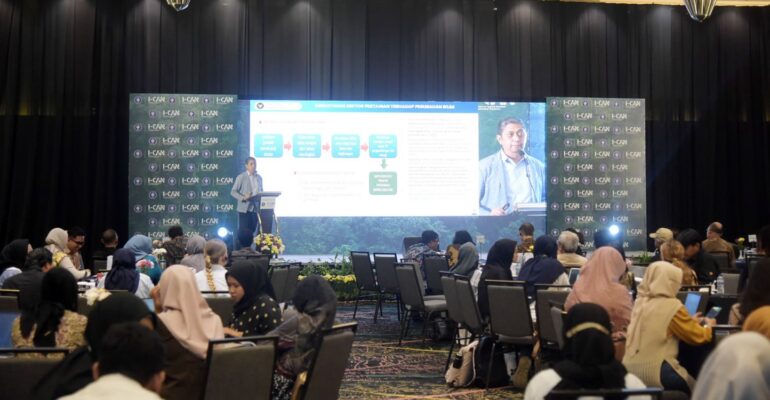
IPB University has officially launched the IPB Centre for Applied Research in Nature-based Solutions (I-CAN) as a multidisciplinary research center to accelerate the implementation of nature-based solutions. I-CAN was established in response to the challenges of climate change, environmental degradation, and national food security.
The launch, which took place at the IPB International Convention Center (IICC), Bogor, on (12/3), marked the strengthening of IPB University’s strategic collaboration with the University of Waterloo, Canada, through the support of the Fincapes project from Global Affairs Canada.
I-CAN Steering Committee member Prof Dodik Ridho Nurrochmat emphasized that the nature-based solutions (NbS) approach is the main foundation for sustainable landscape management.
“This approach places the community as both managers and beneficiaries, so that ecological restoration goes hand in hand with strengthening socio-economic resilience,” he said.
Prof Dodik, who is also Dean of the Graduate School at IPB University, added that the social forestry program is a concrete manifestation of the NbS principle because it provides communities and farmers with access to land management.
Therefore, he said, “The momentum of the launch of I-CAN must be used to strengthen social forestry as a national strategy that promotes sustainability, climate mitigation, green economy, and food security.”
From a policy perspective, Dr Prayudi Syamsuri, Expert Staff to the Minister for Connectivity Management at the Coordinating Ministry for Food Security, highlighted the threat of climate change to national food security. According to him, climate adaptation remains the key to sustainability.
“The government is implementing a comprehensive strategy through the Water–Energy–Food (WEF) Nexus approach, accelerating climate-smart agriculture, strengthening food self-sufficiency, and utilizing renewable energy such as agrivoltaics and village solar panels,” he said.
International collaboration also strengthens the role of I-CAN. Bill Duggan, Project Director of Fincapes-University of Waterloo, Canada, emphasized the importance of partnerships as a space for mutual learning.
“Fincapes is here not only to bring Canadian expertise to Indonesia, but to build a space for mutual learning. From Indonesia, we also learn how science, community, and culture can come together in managing the landscape,” he said.
Meanwhile, Maria Ramirez, First Secretary Development, Embassy of Canada to Indonesia, expressed her appreciation for the launch of I-CAN as a strong manifestation of the Indonesia-Canada partnership.
“Through I-CAN, Canada not only supports research but also strengthens Indonesia’s capacity to deliver inclusive, science-based nature-based solutions that support green economic growth and long-term climate resilience,” she concluded. (AS) (IAAS/NVA)