IPB University and Bappenas Encourage Young People to Drive the Green Economic Transformation
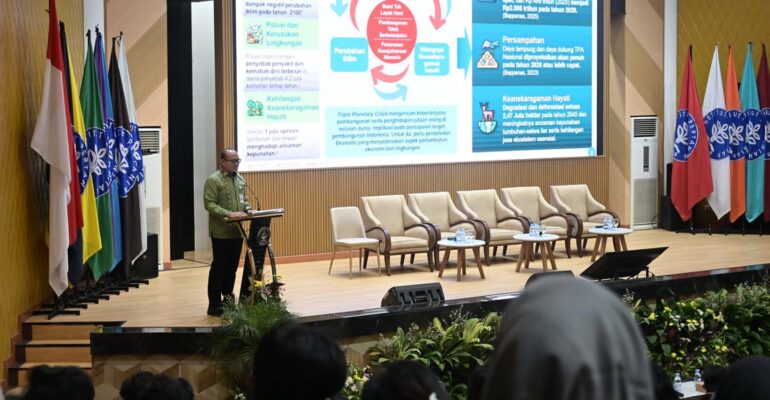
IPB University, in collaboration with the Ministry of National Development Planning/National Development Planning Agency (Ministry of PPN/Bappenas), held a “Green Economy Goes to Campus” event titled “The Role of the Young Generation in Supporting Green Economic Transformation Toward Indonesia Emas 2045” at the IPB Dramaga Campus (5/20).
This event served as a discussion forum for students, academics, and stakeholders to deepen their understanding of sustainable development and the green economy in Indonesia.
IPB University’s Vice Rector for Research, Innovation, and Agromaritime Development, Prof Ernan Rustiadi, emphasized that the campus plays a crucial role in raising the younger generation’s awareness of environmental sustainability. According to him, universities are not merely places of learning but also living ecosystems that must be collectively preserved.
“The theme of biodiversity is crucial because a campus is not just about buildings and lecture halls, but also a living ecosystem where various types of plants and animals coexist,” he stated.
Meanwhile, the Chairman of the International Research Institute for Environment and Climate Change (LRI LPI) at IPB University, Prof Rizaldi Boer, highlighted the importance of human resource readiness in facing the green economic transition. He explained that the demand for workers skilled in green technology will continue to rise in the coming years.
“Universities need to strengthen interdisciplinary and experience based learning so that students can tackle the challenges of the green economic transition,” he said.
He noted that IPB University has developed project based learning and problem based learning approaches to encourage students to directly engage in solving environmental issues and promoting sustainable development. Additionally, startup development, village themed programs, and student innovations are also part of the efforts to support the green economic transformation.
On the same occasion, Indonesian environmental leader Prof Emil Salim emphasized the importance of shifting perspectives in development. In his view, future development must not repeat old patterns that exploit nature without considering ecosystem sustainability.
“If we want to build Indonesia Emas 2045, then the path of development must differ from past development that damaged the environment. Nature is not merely an object to be exploited, but a living system that must be preserved,” he emphasized.
Nizhar Marizi, PhD, Director of the Environment at the Ministry of National Development Planning (Bappenas), who was also present, explained that the government has incorporated green economic transformation into the National Long Term Development Plan (RPJPN) 2025–2045 through low carbon development, strengthening the circular economy, energy transition, and the development of biodiversity based sectors.
In this process, the younger generation is seen as holding a strategic position as agents of change. “Students are not merely beneficiaries of development but also key drivers of sustainable development transformation,” he said.
Through this initiative, IPB University and Bappenas hope to foster more innovations, research, and multi-stakeholder collaborations capable of driving green economic transformation toward an inclusive and sustainable Indonesia Emas 2045. (AS) (IAAS/EXC)