Through the Village Campus, P2SDM IPB University Provides Solutions to Waste Problems in Galudra Village, Cianjur
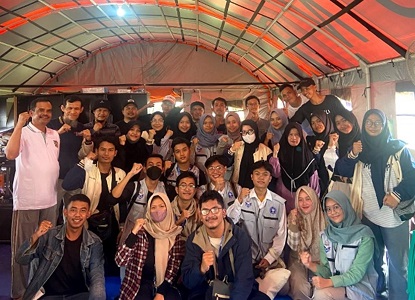
The Center for Human Resources Development (P2SDM) IPB University, through the Village Campus program, held a Community-Based Creative Waste Management training in Galudra Village, Cianjur, West Java. The activity aims to disseminate the science and technology produced by IPB University to the community through waste management by presenting resource persons who are the built communities around the IPB University campus.
Head of Galudra Village, Sugandri, said that the Cianjur earthquake a few months ago still left deep trauma for the residents of Galudra Village. The increasing volume of waste in Galudra Village is also a problem in itself, adding to the stress of local residents.
“Therefore, through the Village Campus program held by P2SDM IPB University, it is hoped that it will be able to solve waste problems and grow employment through a community-based creative economy by empowering housewives,” he explained during an activity at the Mahfuzul Hayati Foundation Hall.
Chair of P2SDM IPB University, Dr Amiruddin Saleh, said empowerment has become the obligation of IPB University as a higher education institution that holds moral and social responsibilities in transferring science, innovation, and technology to the community. Through this Village Campus program, P2SDM IPB University is ready to assist community members in efforts to manage waste creatively based on the community, especially the community of housewives.
“Women are the pioneers of change for this program because they have the ability to disseminate information and innovation to other community members. In addition, mothers are also making an effort to develop based on gender equality, “said Dr Amir.
He added that this Village Campus is IPB University’s response to contributing to solving problems in the community, one of which is the waste problem in Galudra Village. “Therefore, these mothers are invited to later be able to disseminate this information widely to the community, as well as a gender-responsive program,” Amir explained.
On that occasion, Dr Yannefri Bakhtiar, as the supervisor of the Village Campus program, conveyed the importance of maintaining a clean environment. According to him, cleanliness is also a reflection of individuals and the regions where they live. “Therefore, it is time for the residents of Galudra Village to work hand in hand to realize a creative economy-based tourism village that is independent of waste,” he said.
Mukhlis and Sukatma are actors in waste management, both organic and inorganic. Various waste processing products have been produced. Both agreed that household waste, organic and nonorganic, should not be disposed of arbitrarily but must be processed wisely and creatively so as to produce various products of artistic and economic value.
They showed examples of processed waste products, such as ecoenzymes as a substitute for soap, remnants of organic waste for maggot cultivation, and liquid organic fertilizer (POC). Both also use non-organic waste as raw material for making ecobrick pillows and paving blocks. In fact, waste-based products are currently being developed to overcome earthquake-prone areas.
“Currently, we, together with IPB University lecturers, are trying to make products that will be devoted to earthquake-prone areas. Of course, waste is the basic material,” explained Mukhlis. (Rohman/Rz) (IAAS/MZS)