
FPIK IPB University Sends Research Team to Address Lobster Cultivation Issues
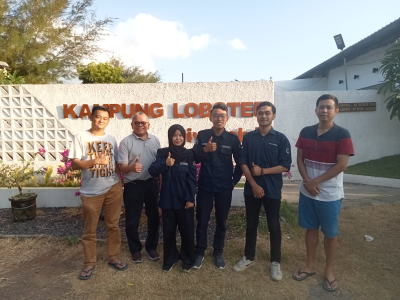
The Faculty of Fisheries and Marine Science (FPIK) at IPB University sends a research team to address issues in the lobster cultivation industry based on mariculture in Bangsring, Banyuwangi, East Java. The efforts taken were in the form of problem identification and formulation of solutions, routine lobster cultivation activities in the open sea, and field practices for IPB University students at the Department of Aquaculture (BDP) in FPIK.
The dispatch of the research team to Bangsring was based on the cooperation agreement between FPIK IPB University and PT Teras Samudera Sejahtera (PT TSS). The IPB University research team was made up of Dr Irzal Effendi, a lecturer from BDP at IPB University, along with three undergraduate and postgraduate students. Additionally, also present during the dispatch were Prof Fredinan Yulianda as the Dean of FPIK IPB University, Hadiyanto as the President Director of PT TSS, and Prof Mala Nurilmala as the Vice Dean in the Resources, Collaboration, and Development field.
Prof Fredinan Yulianda revealed that lobster cultivation at the seabed is quite unique. This is because of the fact that at depths of 10-15 meters, using bottom cages made of iron and steel nets give rise to many challenges, both physically and mentally. However, this matter does not hinder the research team from FPIK IPB University in remaining committed to assisting and resolving the issues faced by the lobster industry.
"The production performance of lobster cultivation can use and benefit from the analysis of oceanographic, hydrological, climatological, and water quality conditions in the area. The design, dimensions, and layout of the bottom cages are also important. Identification of diseases and parasites, as well as prevention and treatment efforts, are necessary. Moreover, the utilization of several modern and applicable cultivation technologies is crucial to enhance production performance," explained Prof Fredinan Yulianda while leading the research proposal discussion.
Hadiyanto, the CEO of PT TSS, gave a warm welcome at the arrival of the research team from FPIK IPB University as it aims to advance lobster cultivation in Indonesia. By sharing the same commitment with FPIK IPB University, this collaboration marks the beginning of a research process that will take place. Hadiyanto mentioned that the main issues faced by cultivators among others include the quality and survival of lobsters.
"As of recently, there has been a decline in lobster production performance. This occurrence is caused by the deterioration of water quality, the emergence of diseases, particularly milky diseases, high mortality rates, and the decrease in productivity," stated Hadiyanto.
Other than cultivation activities, PT TSS also engages in post-harvest handling and processing of lobsters into various culinary dishes served in culinary tourism, including assisting in customer service (waitress).
Correspondingly, this collaboration also serves as a Mariculture Field Practice (PLM) opportunity for students of BDP at IPB University. Further, it is also part of the academic curriculum that students must take and involves various academic resources (lecturers, students, technology, and research equipment) on a broader scale.
With that being said, through this collaboration, it is possible to generate more high-quality publications while remaining focused on solving the challenges faced by the business and industrial sectors. (*/Rz) (IAAS/ZRT)

