IPB collaboration with National Library and Archive Unite Strength in 4.0 Era
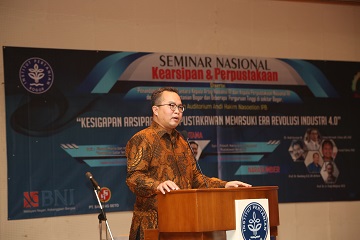
The Library and Archive Unit of Bogor Agricultural University (IPB) in collaboration with the National Library of Indonesian Republic and the National Archive of Indonesian Republic (ANRI) held a National Seminar of "Archivist and Librarian's Readiness on Entering the Industrial Revolution Era 4.0" on Tuesday (10/7) at Campus IPB Dramaga. In this event at once also conducted Memorandum of Understanding (MOU) between IPB with National Library of Indonesia. The signing of IPB cooperation with National Library was conducted by the Rector of IPB, Dr. Arif Satria and Head of National Library of Indonesia, Muhammad Syarif Bando and Head of National Archives, Dr. Mustari Irawan, MPA.
Not only that, IPB facilitated the MoU between the National Library of Indonesia, ANRI, and several universities in Bogor and surrounding areas. These colleges include: Universitas Pertahanan, Nusa Bangsa University, Djuanda University, Ibnu Khaldun University, STIE Kesatuan, Assyafiiyah Islamic University, Siliwangi University and Pakuan University.
Rector of IPB, Dr. Arif Satria, convey congratulations. The cooperation of National Library of Indonesia, ANRI with IPB and universities in Bogor and surrounding areas can make stronger synergy. IPB Rector mentioned that librarian must be able to read signs of change. "By reading the signs of the changing times, the library can adjust according to the needs of the community."
The same thing was conveyed by the Head of National Library of Indonesia, Muhammad Syarif Bando, "It could be the duty of librarian to shift. We are required to move to understand what society needs. How great the people access the library, especially the National Library. How great is the National Library's ability to collect all the information that the community need. Indonesian reading culture is low. I still doubt in the outback of Indonesia, people are diligent in reading books. It could be a book read by 15 thousand people. This means that Indonesia is hungry for books, "said Muhammad Syarif.
The library can bridge the interests of people. Beggar at Kuta Beach, Bali thanks to the book now has a business. Libraries also play a role in economic growth. "There are people in Papua can not access new books. Do not complain about reading culture anymore. A great teacher recommends a book to the meatballs seller. I'm sure it will not be read. Try if you give a book about one cart to dozens of carts, I'm sure it will be read. Give the book what the person is up to. That's the essence of the library. Reading, "said Muhammad Sharif.
Muhammad Syarif further said, the library has a fundamental role is the ability to unite the power. "What is owned by IPB and other universities, let us unite and share together through one application, data migration. Thus hopefully people in the area that has not connected through the National Library can access. Not useful having a collection of books. But the reading culture is low. It is impossible to speak welfare without intelligence, "said Muhammad Sharif.
Therefore, Muhammad Syarif said that the library should do the reorientation of the definition. "It's not just about books, shelves and libraries as a storehouse of knowledge. The definition must be changed immediately. By entering the era of Industry 4.0 as the current culture of reading will increase. In this 4.0 era, 800 million manual jobs will be lost. Never teach a profession that will be taken over by a computer. The profession of teachers and lecturers may one day be replaced by robots too. "
Meanwhile, the head of the national archive, Mustari Irawan, explained the importance of archival roles that are often faced with local, regional, complex, social, economic and political issues. "Many of us do not care about archives. One of the impacts is the Regional Government (Pemda) lost a lot of assets, because its assets are widely claimed by the community. That is the fact. If it happens in many areas, you should imagine how much losses burden to the country. Not to mention many villages are involved in conflict over potential land, so the philosophy of the archive has a big role, "he said (DMR)