Wildlife Falls Victim to Forest and Land Fires, IPB University Expert Reveals the Threat Behind Habitat Loss
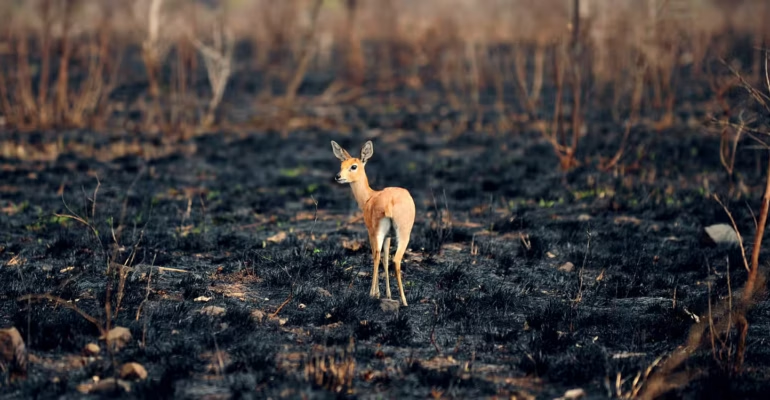
Forest and land fires (karhutla) in Kalimantan and Sumatra not only threaten forest cover but also the survival of endemic and rare wildlife that depend on these ecosystems.
The loss of habitat, food sources, and water sources due to fires can lead to animal deaths, habitat fragmentation, and even trigger conflicts between wildlife and humans.
Dr Abdul Haris Mustari, a lecturer in the Department of Forest Resource Conservation and Ecotourism at the Faculty of Forestry and Environment, IPB University, concluded that the forest and land fires in Kalimantan and Sumatra are inextricably linked to human activities, whether by corporations or individuals. He emphasized that what is happening there is not simply a natural fire but one that has been deliberately set.
“This pattern of fires recurs every year, while prevention efforts tend not to be carried out optimally. The government’s and the public’s response often only intensifies once the fires have spread, making them harder to manage and their impacts even greater,” he said.
He explained that forest and land fires can affect plantation areas, secondary forests, and even primary forests, which serve as critical habitats for wildlife.
“Orangutans, proboscis monkeys, clouded leopards, hornbills, great hornbills, golden cats, elephants, tigers, and tapirs are among the animal groups that may be affected. This habitat destruction poses a serious threat to biodiversity because the ecological functions of the ecosystem could be lost in a short period of time,” he said.
Dr Mustari explained that the most immediate threat is the death of animals due to fires. Meanwhile, animals that manage to escape will face the loss of habitat, food sources, and water. They then seek temporary habitats, such as secondary forests or areas bordering plantations and settlements.
According to him, such conditions have the potential to increase conflicts between wildlife and humans. “In the end, it is always the wildlife that becomes the victim and is blamed. Yet, the wildlife’s displacement from its habitat occurs because its habitat has been destroyed and burned by humans,” he explained.
He added that ecosystem recovery following forest and land fires cannot be measured solely by the regrowth of vegetation. The restoration of food webs and food chains takes an extremely long time, it can even span hundreds of years and does not always return to its original state.
Therefore, Dr Mustari emphasized the need for impartial law enforcement, strengthened prevention efforts, and the protection and expansion of critical wildlife habitats through conservation areas such as national parks, nature reserves, and wildlife sanctuaries.
“It’s better to prevent than to react and panic when forest and land fires occur,” he emphasized.
According to him, public awareness also needs to be strengthened because the impacts of forest and land fires are felt not only by wildlife but also by humans through the degradation of air, food, and water quality. (dr) (IAAS/KQA)