IPB University Expert: Tapir Sightings in Residential Areas Sound the Alarm on Forest Habitat Degradation
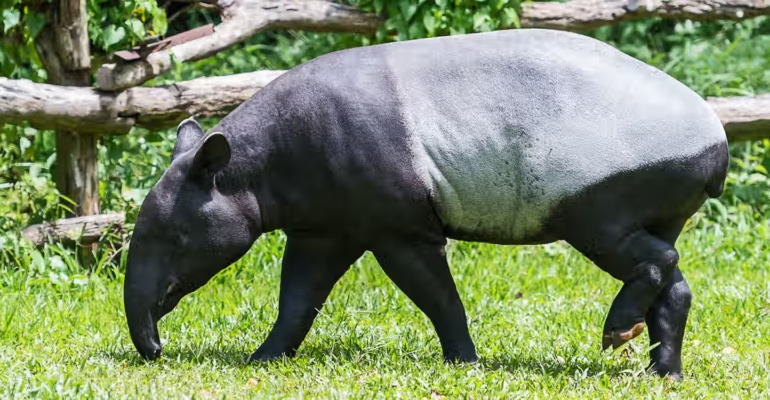
The viral story of a tapir sighting along the Trans-Sumatra Highway (Jalinsum), Register 45, in Mesuji Regency, Lampung, along with reports of its alleged killing by a group of residents, serves as an important reminder of the increasingly precarious state of wildlife habitats.
According to IPB University conservation expert Dr Abdul Haris Mustari, the appearance of tapirs near residential areas is not a common phenomenon, but rather a sign that the forest ecosystem is experiencing serious disruption.
Dr Mustari explained that the Asian tapir (Tapirus indicus) is the only tapir species found on the Asian continent. This odd-toed ungulate measures about 1,8 meters in length, weighs 300–350 kilograms, and is known as a strict herbivore that consumes a variety of plant species.
“Tapirs are shy animals that are highly dependent on forest habitats. Their appearance in human inhabited areas is a sign that something is wrong with their habitat,” he said.
He explained that tapirs have a short snout, which is the result of the evolution of their nose and upper lip over millions of years. This organ functions to select food, detect odors, recognize environmental conditions, and aid in navigation within their habitat.
Asian tapirs live in humid lowland forests and are highly dependent on water sources for drinking, wallowing, and regulating their body temperature.
According to him, the main cause of tapirs leaving their natural habitat is the increasing conversion of forests into plantations, settlements, mining areas, and cleared land. These conditions narrow the animals’ range, reduce food availability, and increase the potential for conflict with humans.
“Tapirs that leave the forest, as in the case in Mesuji, have likely traveled long distances while in a weakened state, lacking food and water, and are actually searching for a safe place. It is truly unfortunate if these protected animals end up meeting a tragic fate due to human actions,” he said.
Dr Mustari added that tapirs play a very important ecological role as seed dispersers in tropical forests. The various plant seeds they consume are dispersed through their feces and grow into new vegetation. In fact, some types of seeds can germinate only after passing through the tapir’s digestive system, meaning tapirs make a significant contribution to forest regeneration.
Furthermore, tapirs are recognized as keystone species, umbrella species, and flagship species, serving as important symbols of successful forest conservation.
From a conservation perspective, the Asian tapir is listed as “Endangered” on the IUCN Red List, is listed in Appendix I of CITES, and is protected by various national regulations, including Law No 32 of 2024, Government Regulation (PP) No 7 of 1999, and Regulation of the Minister of Environment and Forestry (Permen LHK) No 106 of 2018.
Through this event, Dr Abdul Haris Mustari urged the public to increase their awareness of wildlife and preserve its habitat. He emphasized that wildlife is an integral part of the ecosystem’s balance.
“If animals and plants continue to face extinction due to forest destruction, humans will ultimately feel the impact as well. Protecting tapirs means safeguarding the sustainability of our forests and our shared lives,” he concluded. (dr) (IAAS/DAM)