LPA2I at IPB University Accelerates the Commercialization of Research by Strengthening the Legal Status of Innovative Products
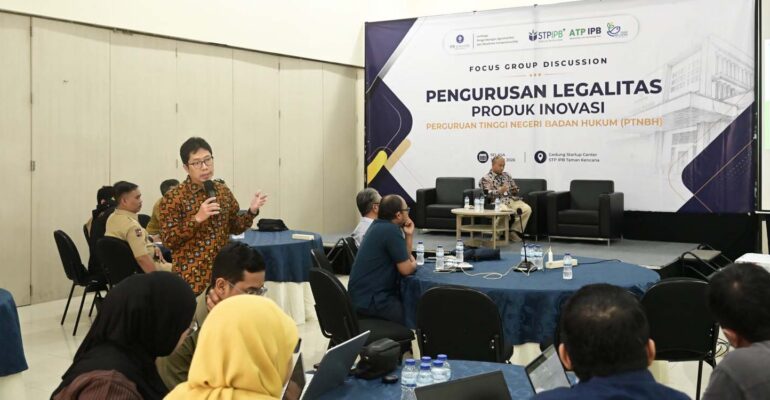
The Institute for Agromaritime Development and Innopreneurship Acceleration (LPA2I) of IPB University held a Focus Group Discussion (FGD) on the Legalization of Innovative Products at State Universities with Legal Entity (PTNBH) at the Taman Kencana Campus (6/30). The activity brought together academics, innovation park managers, and government representatives to discuss regulatory challenges while formulating solutions to accelerate the legalization of research-based products so that they can be utilized more quickly by society and industry.
Vice Chief of LPA2I for Business Incubation and Industrial Partnership, Prof Rokhani, stated that universities are currently required not only to produce scientific publications and patents, but also to downstream research results into products with economic value.
“Legalization is a very important aspect of the innovation downstreaming process. Through this FGD, we want to understand the regulations, identify obstacles in the certification process, and formulate strategies so that innovative products from universities can obtain distribution permits in accordance with the regulations,” he said.
He revealed that the Science Techno Park (STP) of IPB University, through its teaching industry, has currently produced various production lines, ranging from bottled drinking water, flavored beverages, to biscuits and bakery products. Several products have obtained distribution permits from the Indonesian Food and Drug Authority (BPOM) and halal certification. However, the development of new production lines still faces obstacles in the process of adding the Indonesian Standard Classification of Business Fields (KBLI), which is one of the licensing requirements.
“We hope that this forum will provide regulatory clarity. The facilities that have been fully built, along with their machinery, should not remain underutilized due to licensing issues,” he said.
Present as a speaker, Director of Investment Deregulation at the Ministry of Investment and Downstreaming/Investment Coordinating Board (BKPM), Dendy Apriandi, emphasized that the business legalization process must be comprehensively understood through the Risk Based Business Licensing (PBBR) scheme.
He explained that Government Regulation Number 28 of 2025 was issued to improve the previous licensing system by providing certainty in the process, simplifying procedures, and strengthening the regulatory framework.
“A distribution permit is the final stage in the licensing process. Before applying for the permit, business actors must first fulfill the basic requirements, obtain business licenses according to the level of risk, and then complete the supporting business licenses required for business activities,” he explained.
He emphasized the importance of coordination with local governments in fulfilling basic requirements, such as Spatial Utilization Activity Conformity (KKPR), Building Approval (PBG), and environmental documents. In addition, the utilization of the Detailed Spatial Plan (RDTR) is considered capable of accelerating the licensing issuance process through a digital system.
The FGD is expected to produce concrete measures to accelerate the downstreaming of research results from universities so that IPB University’s innovations can enter the market more quickly, be utilized by society, and enhance the competitiveness of the national industry. (AS) (IAAS/FHD)