IPB University Accelerates Research Commercialization Through the Signing of Technology Licensing Agreements and Royalty Payments
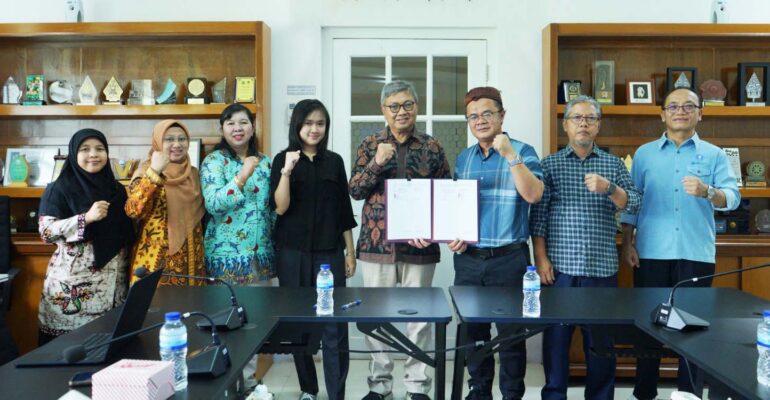
IPB University, through the Institute for Agromaritime Development and Innopreneurship Acceleration (LPA2I), signed a number of technology licensing cooperation agreements with three strategic partners, namely PT Mangunkerta Horti Nusantara, PT Sahabat Nelayan Indonesia, and the Karya Bakti Bumi Indonesia Foundation (YKBBI).
The Chairman of LPA2I, Dr Handian Purwawangsa, reaffirmed IPB University’s commitment to continuously strengthening partnerships with industry, developing business models, and expanding market access. This commitment aims to accelerate the commercialization of research outcomes so that more innovations can be widely utilized.
Currently, IPB University has mapped out 283 innovations based on their readiness level and utilization schemes, whether through exclusive or non-exclusive licensing. According to him, commercialization does not end with the signing of a cooperation agreement but must be able to create an ecosystem that connects upstream research with downstream market needs.
“We are further strengthening the innovation business ecosystem by integrating upstream and downstream activities to ensure they operate synergistically, so that the downstream processing can take place more effectively and sustainably,” he said at an event held at the Science Techno Park (STP) of IPB University on Thursday (6/25).
This collaboration includes licenses for eight chili varieties, one tomato variety, and the Calina papaya variety all innovations by Prof Muhamad Syukur as well as a license for the People’s Livestock School (SPR), developed by Prof Muladno, and a license for the Portable Fish Aggregating Device (FAD), an innovation by Dr Roza Yusfiandayani.
“The Portable Fish Aggregating Device (Rumpon) innovation has been in development since 2013 and has now been commercialized in ten provinces across Indonesia. This technology has also been introduced in Timor Leste, Namibia, and Madagascar, demonstrating the international competitiveness of IPB’s innovations,” said Dr Roza Yusfiandayani, Vice Chairperson of LPA2I for Innovation, Technology Transfer, and Community Empowerment.
As a token of appreciation for the success of this commercialization, IPB University also distributed royalties to researchers whose research findings have been utilized by industry partners. The distribution of royalties serves as proof that innovation not only benefits society but also generates economic value as recognition of the inventors’ intellectual contributions.
One of the innovations currently under development is a ready-to-use cooking seasoning that has received a request from the Indonesian Ministry of Hajj and Umrah to meet the needs of Indonesian pilgrims. In addition, market development efforts continue for flagship innovations, such as the Calina and Calisa papaya varieties.
A number of innovators shared their experiences in developing research outcomes until they were ready for public use. Prof Yuli Retnani noted that support from the Kedaireka program has helped accelerate the commercialization of feed wafer technology by providing supporting facilities and strengthening collaboration with industry.
Meanwhile, Prof Made Astawan views the recognition of tempeh as a UNESCO Intangible Cultural Heritage as a catalyst for enhancing the added value and competitiveness of Indonesian tempeh products in the global market.
Prof Irma Isnafia Arief shared a similar experience, emphasizing the importance of collaboration in overcoming challenges ranging from raw material availability and permitting to product commercialization. On the other hand, Prof Hanny Wijaya noted that royalties are not the primary goal of innovation. In her view, the greatest satisfaction comes when research outcomes can be utilized by the public and commercially produced by industry.
Speaking on behalf of the developers of Ferads 1.0, Prof Ketty Suketi expressed her hope that the royalty reward system would serve as an incentive for researchers to continue producing innovations that bring broad benefits to society.
The signing of the license agreement and the payment of royalties are expected to strengthen intellectual property protection, expand the utilization of research-based technologies, and encourage sustainable innovations that contribute to national development. (*/Rz) (IAAS/EPK)