IPB University and WorldVeg Establish the Taiwan-ASEAN Pest and Disease Surveillance Network
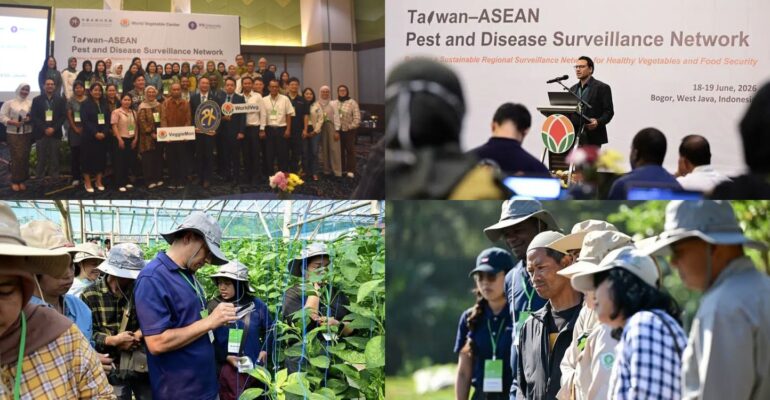
The Department of Plant Protection, Faculty of Agriculture, IPB University, in collaboration with the World Vegetable Center (WorldVeg), launched the Taiwan-ASEAN Pest and Disease Surveillance Network. This cross national collaborative network aims to accelerate the early detection and control of invasive plant pests in vegetable crops across Southeast Asia.
This initiative represents a strategic step to address the growing threat of plant pest and disease spread caused by climate change, international trade, and the high mobility of plant materials.
The Taiwan-ASEAN Pest and Disease Surveillance Network was launched during a regional workshop at the IPB International Convention Center (IICC) in Bogor recently, with funding support from Taiwan’s Ministry of Foreign Affairs (MOFA).
More than 40 participants including researchers, plant quarantine authorities, and technical experts from Taiwan and six Southeast Asian countries, namely Indonesia, Cambodia, Laos, the Philippines, Thailand, and Vietnam, attended the forum.
The Dean of the Faculty of Agriculture at IPB University, Prof Suryo Wiyono, emphasized that regional collaboration is a key pillar in ensuring the sustainability of vegetable production while strengthening Southeast Asia’s food security.
“As a plant pathologist, I understand that surveillance is key to detecting disease threats early on. Cross border collaboration like this is vital for protecting vegetable production and the region’s food security,” he stated.
In line with this, Dr Lourena Maxwell, Project Coordinator and Scientist–Plant Pathology at WorldVeg, emphasized that the threats posed by plant pests and diseases know no national borders.
“Pests and plant diseases do not recognize national borders. Sharing information and strengthening diagnostic capabilities among ASEAN countries will help us respond to emerging threats more quickly and effectively,” she said.
According to her, the establishment of the Taiwan-ASEAN Pest and Disease Surveillance Network is an important step toward strengthening collective preparedness in protecting vegetable production in the region.
Meanwhile, the Agricultural Attaché at the Taipei Economic and Trade Office in Jakarta, Mr Tony SY Hou, expressed Taiwan’s commitment to sharing its experience and expertise in plant pest and disease surveillance systems with ASEAN countries.
He noted that cross border cooperation will accelerate the response to new threats while strengthening plant protection capacity in the region.
During the workshop, delegates identified various major threats to vegetable production in the region.
In addition to long standing concerns such as anthracnose and bacterial wilt, participants also highlighted the emergence of new invasive organisms with significant economic impacts, including tomato brown rugose fruit virus (ToBRFV), Tuta absoluta, and the black chili thrips (Thrips parvispinus).
The results of this assessment will serve as the basis for developing more integrated surveillance and control strategies at the regional level. (*/dr) (IAAS/LAN)