Hands On Learning in the Field, 106 Palm Oil Farmers from Muara Enim Participate in Practice Based Training
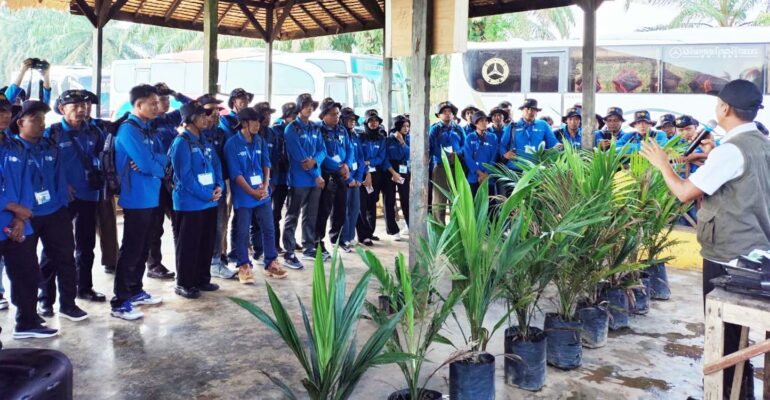
A total of 106 oil palm farmers from Muara Enim Regency, South Sumatra, participated in the Technical Training on Oil Palm Cultivation organized by the Plantation Fund Management Agency (BPDP), the Directorate General of Plantations of the Ministry of Agriculture, in collaboration with IPB Training (6/18–23).
This activity, which is part of the 2026 Oil Palm Plantation Human Resources Development Program, features a learning approach that emphasizes hands on practice and field experience.
IPB Training Director Muhammad Sigit Susanto, MM, explained that the practice based learning approach is one of the key strengths of this training.
“Farmers will find it easier to understand the material when they see and practice it firsthand. Therefore, this training consists not only of classroom lectures but also various simulations, practical exercises, and field visits that closely mimic real world conditions on plantations,” he said.
During the training, participants were actively engaged in various practical activities. In the seedling session, participants practiced the transplanting process moving seedlings from the pre-nursery stage to the main nursery. They also conducted simulations on filling growing media, digging planting holes, and learning proper seedling handling techniques to produce healthy and productive plants.
Not only that, participants also gained experience using various tools commonly used in oil palm cultivation. Hands on exercises using pH meters and litmus paper were conducted to help participants understand soil conditions and management requirements. Meanwhile, practice sessions with knapsack sprayers provided insight into effective and efficient techniques for applying pesticides and herbicides in the field.
The participants’ enthusiasm was particularly evident during the planting point determination simulation. Using simple measuring tools, participants learned to determine the appropriate planting pattern to support plant growth and optimize land productivity.
The highlight of the training was a field visit to the Sembawa Oil Palm Research Center (PPKS). There, participants had the opportunity to witness firsthand the implementation of standardized oil palm cultivation practices, from nursery operations to the management of bearing trees (TM).
In the nursery area, participants learned techniques for irrigation, weed control, fertilization, pest and disease control, and the selection of high quality seedlings. During the observation in the Non-Producing Plant (TBM) area, participants studied various techniques for maintaining young plants so they can grow optimally and be ready to enter the production phase. Meanwhile, in the TM area, participants gained an understanding of productive crop management, fruit ripeness assessment, and harvesting practices using standard compliant equipment.
The field visit was accompanied by oil palm experts and practitioners who provided on site explanations at each learning station. These interactions gave participants the opportunity to explore solutions to the various challenges they face in their own plantations.
Through a combination of theoretical instruction, practical exercises, and field visits, this training is expected to accelerate the transfer of technology and knowledge to smallholder oil palm farmers. As farmers’ technical skills improve, plantation productivity can continue to rise, thereby supporting the development of productive, competitive, and sustainable oil palm plantations. (*/Rz) (IAAS/LAN)