IPB University Commemorates the 100th Anniversary of Sajogyo, the ‘Father of Indonesian Rural Sociology’
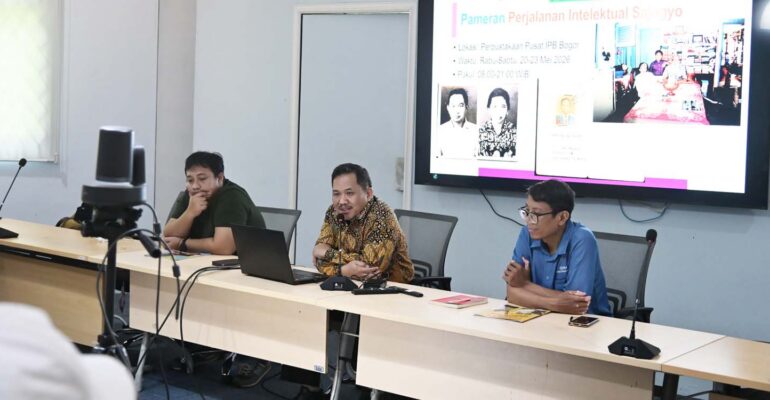
IPB University is commemorating the 100th anniversary of Prof Sajogyo’s birth through a series of international conferences and academic activities from May 18–23, 2026.
This milestone serves as an effort to revive Sajogyo’s critical thinking on agricultural development, poverty, and social justice amid challenges such as the food crisis, rural urban inequality, and global climate change.
According to the website museum.ipb.ac.id, this figure whose real name was Sri Kusumo Kampto Utomo is one of the key figures who significantly influenced the history of IPB University’s development. He was born in Karanganyar-Kebumen on May 21, 1926.
Sajogyo’s life journey was inseparably linked to his contributions, particularly in the social and agricultural sectors. In 1980, he pioneered the concept of “Rural Economics.” His work led students and colleagues to bestow upon Sajogyo the title “Father of Indonesian Rural Sociology.”
Dr Ivanovich Agusta, Chairman of the Center for Agricultural and Rural Development Studies at IPB University, stated that Sajogyo’s ideas remain highly relevant for addressing various current development challenges.
According to him, development must not only be oriented toward economic growth but also toward social justice and a commitment to the lower strata of society.
“Sajogyo’s ideas remind us that development must prioritize the common people, especially rural communities. These values remain relevant amid the current challenges of food crises, poverty, and social inequality,” said Dr Ivanovich at the press conference marking the 100th anniversary of Sajogyo at the IPB Dramaga Campus in Bogor (5/19).
He explained that Sajogyo is known as an academic who championed a multidisciplinary approach to rural development.
Aside from introducing the concept of “modernization without development,” Sajogyo also proposed the Sajogyo Poverty Line, which uses a basic needs approach based on rice consumption to measure community prosperity.
“Sajogyo viewed rural sociology as a hybrid discipline that integrates sociology, anthropology, economics, and customary law to comprehensively understand rural issues,” he said. This approach is considered relevant for formulating inclusive development policies in Indonesia.
Additionally, Dr Ivanovich noted that the 100th anniversary of Sajogyo is not merely about commemorating history but also serves as an academic space for reflection to develop fairer and more sustainable alternative development models.
He added that Sajogyo’s intellectual legacy is important for strengthening food sovereignty, equitable distribution of resources, and social solidarity within the community.
The series of commemorative events includes a book fair, an exhibition tracing Sajogyo’s intellectual journey, a farmers’ market, an international conference, and the launch of several books related to Sajogyo’s ideas. The international conference will feature academics from various countries discussing issues of decolonization in the social sciences, the climate crisis, alternative development, and the future of a just food system. (dr) (IAAS/EXC).