TEP IPB University Increases Sago Forest Productivity, Turns Sago Waste into Mushroom Cultivation Media in Tambat Village
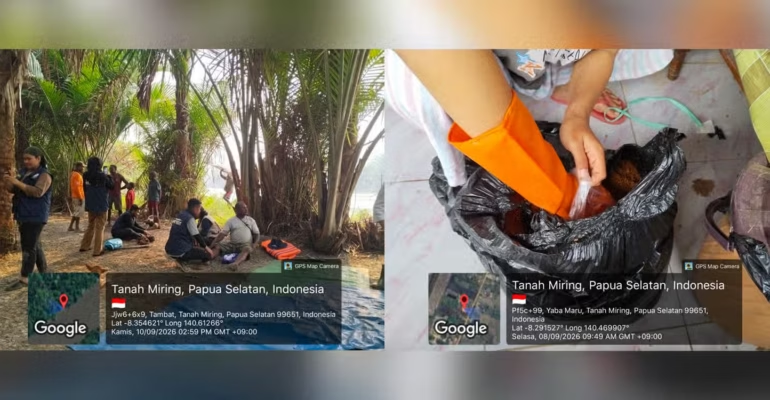
The IPB University Patriot Expedition Team (TEP) is encouraging increased sago forest productivity while utilizing sago waste as a medium for mushroom cultivation in Tambat Village, Salor District, Merauke Regency, South Papua Province.
Sago is one of the local potentials that plays an important role for the community. However, suboptimal sago forest management remains a challenge for local farmer groups. Irregular spacing between trees causes some plants to grow too close together and compete with each other for nutrients.
This condition can lead to unbalanced plant growth and potentially affect sago starch production. On the other hand, successful plant regeneration also continues to face obstacles because some of the sago seedlings planted have died.
Strategy to Increase Sago Forest Productivity
This condition indicates the need for more appropriate planting patterns and seedling management. In response to this, TEP IPB University under the coordination of Ririh Sekar Mardisiwi introduced more appropriate sago cultivation and forest management techniques, one of which is setting a planting distance of around 10 meters between trees.
“A more regular planting distance can reduce competition between plants for nutrients, water, and growing space, allowing sago growth to take place more optimally,” said Ririh during the 2026 TEP IPB Internal Monitoring and Evaluation activity recently.
In addition to regulating planting distance, the use of superior sago seedlings is an important factor in supporting successful cultivation. Seedlings with good growth quality have the potential to produce more adaptive and productive plants when supported by appropriate planting techniques and land management.
The application of these techniques can be introduced through the establishment of demonstration plots or pilot plots. Demonstration plots serve as a learning facility to directly observe the application of planting distances, seedling selection, planting techniques, and plant development.
“This approach helps farmer groups understand the relationship between land management and sago growth while also serving as a reference for implementing more measurable cultivation techniques,” said Ririh.
Turns Waste into Mushroom Cultivation Media
Ririh said that not only sago starch can be utilized, but the waste from sago processing in the form of tree trunks can also be used as a medium for mushroom cultivation. Unused sago tree trunks are crushed and chopped into small pieces until they resemble sawdust. They are then packed into several bags and perforated to place the mushroom seedlings.
“We apply integrated cultivation, in which the by-products of sago production, such as pulp, can also be further processed into animal feed, compost, and even mushroom cultivation containers,” Ririh concluded.
In addition, sago starch pulp can be reused as a mixture for animal feed. This utilization opens opportunities for farmer groups to process sago processing waste into productive activities as well as alternative business opportunities.
Through strengthening cultivation knowledge and waste utilization, sago processing is expected to become more efficient and provide broader benefits for farmer groups and the community of Tambat Village. (IAAS/HRD)