IPB University’s Patriot Expedition Team Holds Training on the Formulation and Application of Liquid Organic Fertilizer
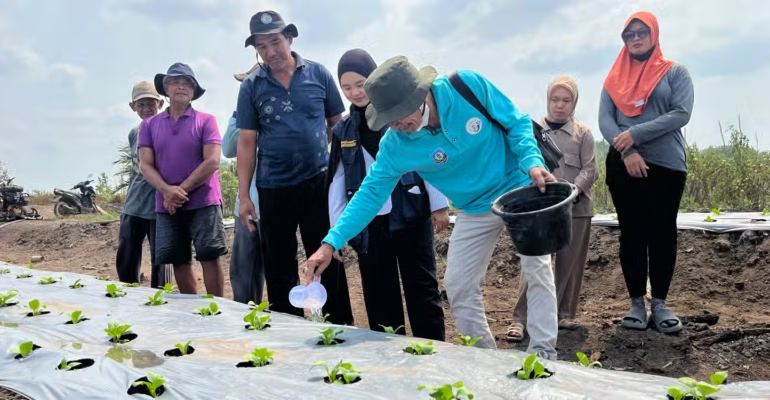
IPB University’s Patriot Expedition Team (TEP) held a training session on the formulation and application of liquid organic fertilizer (POC) as part of the Farmer Field and Business School (FFBS) program at the Batu Betumpang Transmigration Area in South Bangka Regency (9/19).
The event featured Suhudi, Chair of the Sidoharjo Village Farmers’ Group (Gapoktan) and Chair of the Alam Lestari P4S, as a guest speaker, and was attended by Panca Tunggal Village Head Nurdin and Sumber Jaya Permai Village Chief Thoha Maksum.
According to the Field Coordinator of TEP IPB University, Anindito Muhammad, SP, MSi, this activity aims to encourage a gradual transition toward the adoption of a sustainable agricultural system based on the utilization of local resources (local resource-based agriculture).
“This program is also expected to address rising prices and shortages of inorganic fertilizers, as well as tackle local edaphic challenges such as acidic soil and limited water supply,” he added.
Panca Tunggal Village Chief Nurdin expressed his full support. He commended this initiative as a concrete solution to the high cost of chemical inputs that burden the community.
“Chemical fertilizers are becoming expensive, so farmers really need to make the most of available resources by producing organic fertilizer. We hope the farmers attending this FFBS event will be able to put these practices into action,” said Nurdin.
Suhudi noted that the transition to environmentally friendly farming practices doesn’t have to start with complex technology, but rather through the optimization of biomass that’s easily accessible to local communities. “Organic farming is about finding what’s easy, not what’s difficult,” Suhudi emphasized while leading the formulation session.
A similar enthusiasm was expressed by FFBS participant Ayik Sofyan. “This is a huge help for farmers who are currently facing high fertilizer prices and supply shortages. With this activity where we’re making organic fertilizer, hopefully farmers will be interested and start using organic fertilizer,” he said.
Through the FFBS approach, participants were guided to directly practice techniques for making POC (organic liquid fertilizer) based on the fermentation of local organic waste. This approach employs a gradual transition strategy, in which the 18 trained farmer leaders are encouraged to conduct trials, empirical evaluations, and adjustments to input ratios based on their respective land types, thereby enabling them to serve as agents for the horizontal diffusion of innovation to a broader network of farming groups in Batu Betumpang on a sustainable basis. (*/Rz) (IAAS/LAN)