IPB University’s LPA2I, the Bulungan Regency Government and YKAN Strengthen the Capacity of Bulungan Farmers Through the Agrocomplex Field Schoolc
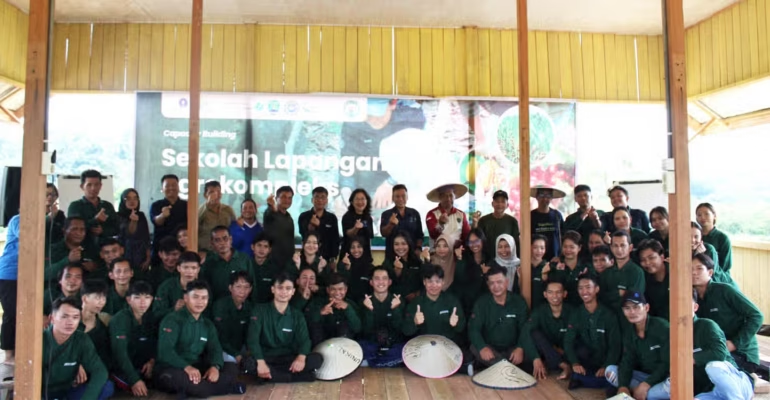
IPB University, through the Institute for Agromaritime Development and Innopreneurship Acceleration (LPA2I), is playing a role in strengthening community capacity through the Agrocomplex Field School program in Long Buang Village, Peso District, Bulungan Regency, North Kalimantan.
Together with the Bulungan Regency Government (Pemkab) and the Nusantara Nature Conservation Foundation (YKAN), IPB University supports field based, hands on learning that integrates scientific knowledge, farmers’ experiences, and the potential of local resources to promote productive and sustainable agricultural development.
The one year program, which runs through November 2026, involves 46 participants, consisting of 30 farmer representatives from Peso Subdistrict, 10 students from Kaltara University, and 6 Field Agricultural Extension Officers (PPL) from the Bulungan Regency Agriculture Office.
“Through the Agrocomplex Field School, IPB University continues to foster collaboration between universities and the community to deliver knowledge and innovations that can be practically applied,” said Bonjok Istiaji, SP, MSi, Assistant for Farmer and Fisherman Development at LPA2I, IPB University.
He hopes this program can support agricultural development in Bulungan Regency toward a more integrated, productive, adaptive, and sustainable system.
The involvement of TNC LPA2I IPB University ensures that participants not only gain theoretical understanding but also develop knowledge and skills through hands on practice based on real world field conditions.
Participants observed agroecosystem conditions, conducted practical exercises, engaged in discussions, identified issues, and evaluated learning outcomes in accordance with the characteristics of their respective regions.
The Regional Secretary of Bulungan Regency, H Risdianto, stated that the program is one of the steps toward strengthening community capacity while promoting productive and sustainable green development.
“This program is a concrete step toward realizing sustainable green development. Through the Field School, the community not only gains knowledge but also hands-on experience that can be applied according to the conditions of their respective regions,” said Risdianto.
The program’s implementation aligns with the policy direction of the Bulungan Regency Medium-Term Regional Development Plan (RPJMD) 2025–2030, which designates the western corridor particularly Peso Subdistrict as a rapidly growing area based on integrated agriculture, plantations, livestock, and fisheries.
“The western corridor is one of the region’s development priorities. Therefore, enhancing farmers’ capacity is a crucial component to ensure that the region’s potential can generate added value for the community,” he explained.
The Agrocomplex Field School program is structured into eight progressively organized learning sessions. One of the key approaches introduced is agrosilvopasture, a land management model that sustainably integrates the agriculture, forestry, and livestock sectors.
“This approach is expected to enable participants not only to understand the concept but also to apply, develop, and even replicate the agrosilvopastoral system in accordance with the characteristics of their respective regions,” explained Risdianto.
The collaboration with YKAN reinforces the sustainability perspective, while the involvement of TNC LPA2I IPB University strengthens the capacity-building aspect through a learning approach that connects scientific knowledge, innovation, and community practices in the field.
Through this program, it is hoped that increased agricultural productivity will go hand in hand with efforts to preserve the environment and ensure the sustainability of natural resources. The experiences and lessons learned are also expected to serve as a model that can be developed and replicated in other regions according to each area’s specific characteristics and potential. (*/Rz) (IAAS/SSR).