IPB University Master’s and Doctoral Students in Family Studies Examine Digitalization and Technology Penetration Among Baduy Families
The advent of smartphones and the internet has not only changed the way people access information but can also influence communication, child rearing, intergenerational relationships, and the transmission of values within families.
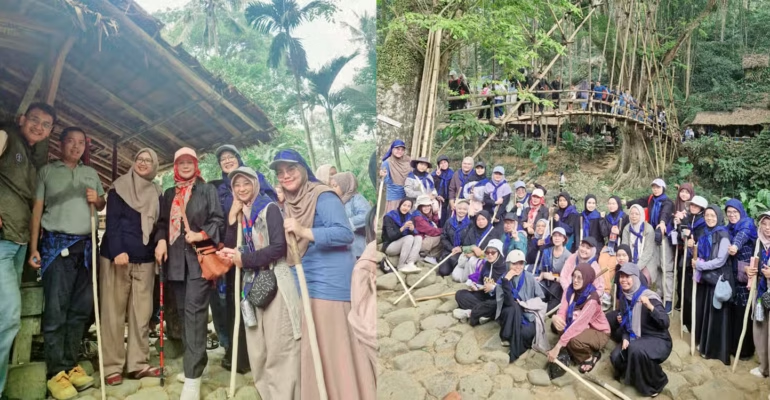
These changes were a key focus of the field study conducted by IPB University graduate students in the Baduy region, Lebak Regency, Banten (9/12–13).
The activity was attended by 43 students, consisting of 36 students from the Master’s Program in Family and Child Development (IKA) and 7 students from the Doctoral Program in Family Studies, Faculty of Social and Human Ecology (FISEMA), IPB University.
Through family interviews and direct observation, students examined how technology has entered the lives of families with strong traditional value systems and customs. The study focused on access to and use of smartphones and the internet, differences in experiences across generations, changes in family communication patterns, and traditional restrictions on technology use.
Digitalization is also examined in relation to children’s education, livelihoods, product marketing, tourism, and interactions with the outside community. On one hand, technology can expand access to information and economic opportunities. On the other hand, its use can present challenges regarding parental supervision, the quality of family interactions, child protection, privacy, and the sustainability of values passed down across generations.
Prof Euis Sunarti, a Full Professor of Family Studies at IPB University and the program’s academic advisor, explained that technology cannot be viewed merely as a symbol of progress or as a threat to the family.
“The issue is not simply the presence or absence of technology, but how families interpret, manage, and use it. Technology can be a family resource, but it also carries risks if not accompanied by boundaries that align with family and community values,” she said.
According to Prof Euis, a family’s ability to manage the penetration of technology is part of family dynamics and resilience. Family responses may vary depending on adherence to traditional values and customs, digital knowledge and literacy, parenting styles, socioeconomic conditions, access to technology, and the influence of the social environment.
The study also highlights the importance of creating a family friendly digital environment. Such an environment not only provides access to technology but also protects children, strengthens parental capacity, encourages responsible use, and provides space for communities to preserve their cultural values and identity.
This field study integrates project-based learning and problem-based learning approaches into the courses Family Dynamics, Family Resilience and Policy, and Family and Development. Students are encouraged to connect the concepts learned in class with the realities of change experienced by families and communities.
The field course was led by Prof Euis Sunarti as the course instructor, assisted by Dr Defina, Rahmi Damayanti, MSi, and Muhammad Fikri Maulana, MPsi. Through this learning experience, students are expected to formulate analyses and recommendations that are not only responsive to technological developments but also respect the values, needs, and characteristics of indigenous families. (*/Rz) (IAAS/HLF)