Collaboration Between IPB University’s IndoDairy 2 Team and KPSP Saluyu Improves the Quality of Cooperative Services for Dairy Farmers
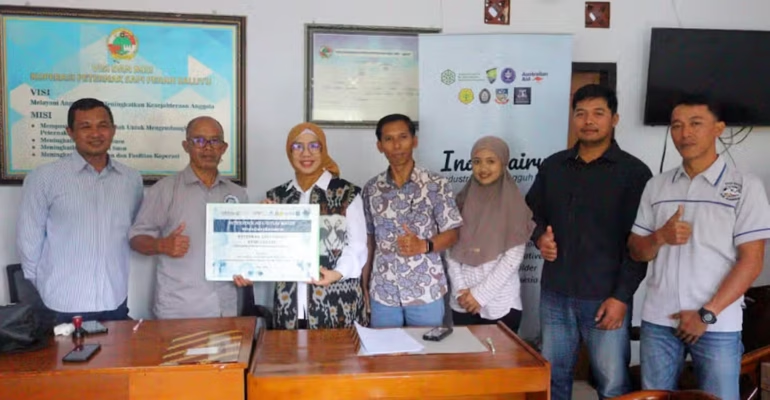
As a concrete effort to boost the productivity of local dairy farmers, the IndoDairy 2 research team at IPB University officially established a strategic partnership with the Saluyu Dairy Farmers Cooperative (KPSP), marked by the signing of a cooperation agreement (PKS) in Cigugur Subdistrict, Kuningan Regency.
The signing of this MoU marks a concrete step and a commitment by both parties to accelerate the improvement of the cooperative’s service quality for all its members. This program is part of the IndoDairy 2 project, funded by ACIAR (Australian Centre for International Agricultural Research), with a primary focus on strengthening a cooperative service approach based on farmers’ needs.
Prof Sahara, the IndoDairy 2 Project’s In-Country Coordinator and Director of the International Trade Analysis and Policy Studies (ITAPS) at IPB University, stated that the program’s approach is participatory and tailored to the actual needs of livestock farmers in the field.
“The IndoDairy 2 intervention focuses not only on livestock health and increased productivity but also on strengthening cooperative governance. As a result, cooperative services are expected to better meet farmers’ needs, which in turn can increase their income.”
“We hope that the mentoring over the next 18 months can serve as a learning experience and a model for other cooperatives,” said Prof Sahara.
Similarly, the Chair of KPSP Saluyu, Antonius Aman, said, “We are very grateful for the support from the IndoDairy 2 IPB University team. Through this intervention, we are optimistic that the focus on improving the quality of dairy workers, providing automatic drinking water facilities (ad libitum), and training for farmers can increase KPSP Saluyu’s milk production,” concluded Mr Aman.
To ensure the program runs smoothly, the IndoDairy 2 IPB University team also held meetings and coordinated with the Kuningan Regency Office of Cooperatives, Small and Medium Enterprises, Trade, and Industry (Dinkop UKM Perindag) as well as the Kuningan Regency Office of Fisheries and Livestock (Diskanak).
“We extend our deepest gratitude to IPB University for coming to Kuningan Regency. We hope that the IndoDairy 2 program will serve as a catalyst and reinforcement for KPSP Saluyu to transform its cooperative management.
Our livestock sector has enormous economic potential, and through this ongoing assistance, our livestock farmers can recover and grow stronger in the future,” said the Chief of the Kuningan Regency Office of Cooperatives, SMEs, and Trade, H Toni Kusumanto, AP, M.Si.
Building on this support, the Chief of the Kuningan Regency Animal Husbandry Service, Dr H Asep Taufik Rohman, also highlighted the technical challenges faced by dairy farmers, particularly during the recovery period following an animal disease outbreak. He has high hopes that IPB University’s intervention will increase farmers’ incomes.
“We are very grateful for the intervention program from the IndoDairy 2 project. It is true that the Saluyu Cooperative is currently facing severe challenges due to the lingering effects of the foot and mouth disease (PMK) outbreak. However, we are encouraging our fellow farmers that the current situation is hopefully like an arrow being drawn back, so that it can then shoot forward at full speed. “We hope that IPB’s involvement can provide tangible benefits so that our farmers can bounce back and compete effectively,” he emphasized.
The intervention at the Saluyu KPSP is expected to serve as the first step in developing a cooperative service model oriented toward farmers’ needs through a bottom-up approach.
From an academic perspective, the evidence and lessons learned from this intervention are also expected to serve as a foundation for the development of evidence based policies aimed at strengthening cooperative governance and advancing the national dairy sector. (*/Rz) (IAAS/KQA)