From Agricultural Drone Trials to Analyzing the Rice Value Chain, IPB University’s TEP Strengthens Papua’s Rice Agribusiness
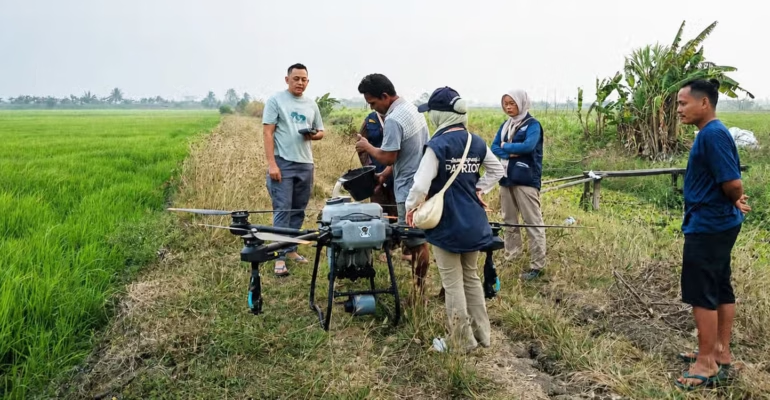
The IPB University Patriot Expedition Team (TEP), led by Dr Doni Sahat Tua Manalu, is collaborating with strategic cross-sector partners—including the Indonesian National Armed Forces (TNI), businesses, local governments, and farmers—to promote the modernization of rice cultivation in Merauke Regency.
This strategic initiative was implemented through a trial of Agras drone technology with a 20-liter capacity on three hectares of rice fields owned by local farmers, while also holding a “Focus Group Discussion (FGD) on the Analysis of the Local Rice Business Value Chain” at the Kodam XXIV/Mandala Trikora Auditorium.
The use of the Agras drone has proven to significantly boost the efficiency of fertilizer and pesticide spraying compared to manual methods. For a one hectare plot, the drone takes less than 20 minutes and requires only two tanks of liquid, whereas the manual method takes up to four hours and requires 20 tanks.
“This drone significantly saves labor, water, fertilizer, and pesticides,” said Margono, a farmer who owns the land being sprayed.
The use of this technology is also considered well suited to the conditions in Merauke, where farmers typically own plots of land as large as 10 hectares. However, the team noted that the use of these heavy drones requires adequate farm road infrastructure, especially during the rainy season on swampy land.
Wilda, one of the team members, proposed the idea of establishing a Drone School for farmers in Merauke. “The school is expected to serve as a learning platform for farmers and local operators to understand the proper operation, maintenance, and use of drones in agricultural activities,” she said.
FGD on the Rice Value Chain
To address efficiency at the cultivation level, the IPB University team held a FGD that brought together farmers, extension workers, rice milling unit (RMU) managers, local government officials, and business operators in the hotel, restaurant, and cafe (horeka) sectors. This forum examined issues across the entire rice value chain, from upstream to downstream, including challenges related to high-quality seeds, irrigation gates, limited harvesting equipment, and the supply of subsidized diesel fuel.
Tanah Miring Police Chief, Wilustono, emphasized the importance of intervention at every point in the distribution chain. “No link in the rice business value chain should be broken. All parties are expected to benefit equally. Therefore, intervention is needed at every stage of the chain,” he stated.
All field efficiency data and community feedback from this FGD were compiled by the team into an official recommendation report. “We will organize these various community proposals into a matrix or proposal so they can be forwarded to the relevant departments,” explained Doki, one of the team members.
This integration from upstream to downstream is expected to increase the economic value returned to farmers and create a self sufficient and sustainable Merauke rice business ecosystem. (*/Rz) (IAAS/KQA)