IPB University and Germany Strengthen Collaboration to Accelerate Energy Transition, Launch Solar Cold Storage Facility
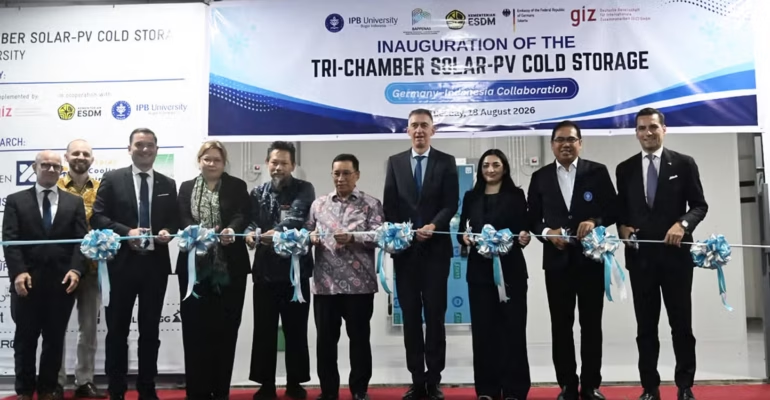
IPB University, the Government of Germany, and several government partners are strengthening their collaboration to accelerate a sustainable and just energy transition that supports economic growth.
The commitment was highlighted during an official visit by the Federal Minister for Economic Cooperation and Development of Germany or Bundesministerium für wirtschaftliche Zusammenarbeit und Entwicklung (BMZ), Reem Alabali Radovan, to IPB University (8/18). The visit was accompanied by a guest lecture on Global Energy Transition and the inauguration of a solar cold storage facility.
Impactful Research and Innovation
IPB University Rector Dr Alim Setiawan Slamet welcomed support from the Government of Germany through Deutsche Gesellschaft für Internationale Zusammenarbeit (GIZ) for the development of the solar cold storage facility at IPB University. He said that the energy transition requires research, innovation, education, and international collaboration.
“The energy transition and sustainability are highly relevant to IPB University’s mission and strategic priorities. Through the Agromaritim 5.0 framework, we seek to connect research and innovation with education and community development to create meaningful impacts for society and the nation,” said Dr Alim.
The solar cold storage facility will also serve as a living laboratory for researchers, lecturers, and students to develop research on clean energy and post harvest technology in tropical regions.
In her public lecture, Reem Alabali Radovan emphasized the important role of young people in addressing the climate crisis and advancing the energy transition.
“Young people are not merely recipients of our policies. You are agents of change. You are the people who need to change the situation for all of us,” said Reem.
She said that the impacts of climate change are already being felt in many countries. However, countries in the Global South are experiencing more severe impacts, despite contributing less to the causes of climate change.
Reem also highlighted the solar cold storage facility, which uses solar energy to cool and freeze agricultural products.
“This cold storage facility creates three benefits at once. First, it accelerates Indonesia’s energy transition. Second, it strengthens the domestic food supply chain. Third, it creates local employment opportunities,” she explained.
On the occasion, Vice Minister of National Development Planning/Vice Chair of the National Development Planning Agency of the Republic of Indonesia (Bappenas), Febrian Alphyanto Ruddyard, emphasized that the energy transition must ensure that energy remains available and affordable, industries remain competitive, and the economy continues to grow. The government is also targeting net-zero emissions by 2060 or earlier.
He emphasized that the energy transition must be accompanied by economic diversification, skills development, green jobs, social protection, and investment in affected areas.
Solar Energy to Support Food Security
Director of Renewable Energy at the Directorate General of New, Renewable Energy and Energy Conservation, Ministry of Energy and Mineral Resources (ESDM), Tony Susandy, said that IPB University’s solar cold storage facility is a concrete example of how renewable energy can support food security and community economic activities.
“This solar cold storage facility is a concrete example of how the energy transition, food security, technological innovation, and international cooperation can come together to create practical solutions,” said Tony.
The facility is the result of collaboration between IPB University and the Ministry of Energy and Mineral Resources through the Tri Chamber Solar PV Cold Storage project, implemented by GIZ. Tony expressed hope that the model could be replicated in various regions, particularly areas that still face limited access to reliable electricity and cold chain infrastructure. (Fj) (IAAS/CAA)