Getting to Know Bionusa Sorghum, an IPB University Superior Variety with a Production Potential of 5,79 Tons per Hectare
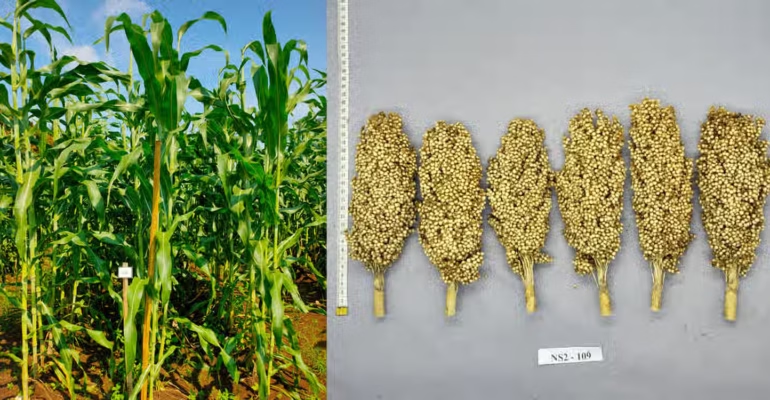
IPB University has developed Bionusa sorghum as a superior variety with the potential to support food diversification while also serving as a source of animal feed. The variety has a grain yield potential of up to 5,79 tons per hectare and green biomass production of up to 45,5 tons per hectare.
Professor from the Faculty of Agriculture at IPB University, Prof Desta Wirnas, explained that Bionusa sorghum was developed by combining the superior characteristics of two national varieties: Numbu and Samurai 2.
The Numbu variety is widely utilized as a food ingredient, both in the form of whole grains and flour, while Samurai 2 possesses characteristics that make it suitable for feed production.
“By crossing Numbu and Samurai 2, the characteristics suitable for both food and feed are expected to be combined in a single variety,” said Prof Desta.
In addition to its dual-purpose function, Bionusa sorghum was also developed to achieve high production potential. Based on its development results, the variety has a grain yield potential of up to 5,79 tons per hectare, green biomass production of 45,5 tons per hectare from the main crop, and a juice content of 14,17 percent.
Adaptable to Various Land Conditions
These advantages make Bionusa sorghum suitable for development under various land conditions. According to Prof Desta, sorghum is a highly adaptable crop that can be cultivated on dryland or upland fields, both in fertile and marginal areas.
This adaptive characteristic presents an important opportunity for sorghum development in Indonesia. Moreover, utilizing dryland can serve as an alternative for expanding the production base for food and feed without relying heavily on paddy fields.
Prof Desta believes that Indonesia has the potential to become one of the leading sorghum producers in Asia.
“Indonesia should be able to become a producer and exporter of sorghum because cultivation technologies are already available, numerous varieties with different advantages have been developed, and sufficient land is available, particularly dryland,” she explained.
With the support of cultivation technologies, superior varieties, and the utilization of dryland, Bionusa sorghum represents one of the innovations that can strengthen the development of sorghum as a strategic food and feed commodity in Indonesia. (dr) (IAAS/CAA)