Overloading Animals Can Lead to Criminal Penalties, IPB Experts Highlight the Importance of Animal Welfare
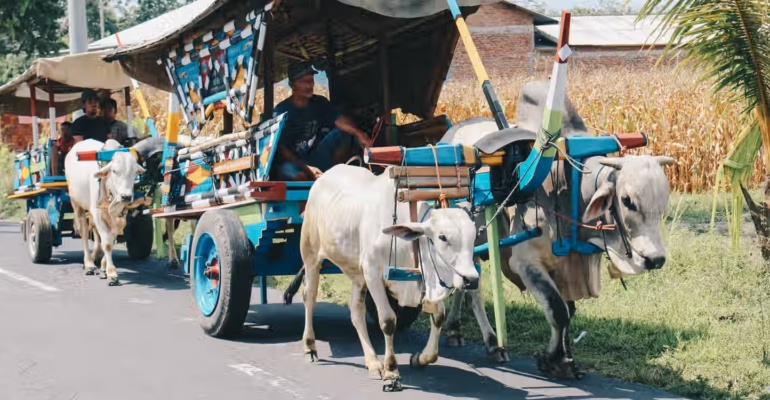
Lecturers from the School of Veterinary Medicine and Biomedical Sciences (SKHB) at IPB University, Prof drh Gunanti emphasized that forcing animals to carry loads beyond their capacity is an act that potentially violates the law and is subject to criminal penalties.
This statement was made following the circulation of a video on social media showing a cow being forced to walk while carrying a heavy load in a procession.
Prof Gunanti explained that animal welfare in Indonesia is regulated by Law No 18 of 2009 on Animal Husbandry and Animal Health, as amended by Law No 41 of 2014. Article 66 of the law requires everyone to treat animals humanely during capture, housing, care, and transportation.
“Forcing a cow to walk long distances with a load exceeding its physiological capacity violates the principles of animal welfare and can be classified as a form of animal cruelty,” she explained.
She added that these provisions are reinforced by Government Regulation No 95 of 2012, which adopts the “five freedoms” principle for animals: freedom from hunger and thirst, freedom from pain or injury, freedom from discomfort, freedom from cruelty, and freedom to express natural behaviors.
From a criminal law perspective, Prof Gunanti explained that perpetrators can be charged under provisions in the Criminal Code (KUHP) as well as the National Criminal Code, which will take effect in 2026.
“In the old Criminal Code, animal cruelty is regulated under Article 302, and the use of animals for work beyond their capacity is regulated under Article 540. Meanwhile, the National Criminal Code addresses criminal offenses against animals in Articles 336 through 338, with the threat of heavier fines,” she explained.
Essentially, the use of cows, water buffalo, and horses as draft animals has long been part of rural life and is not prohibited. However, Prof Gunanti noted that such practices must still respect the biological limits of the animals.
“The issue is not the use of the animals themselves, but rather when the intensity of work, duration, or load weight exceeds reasonable limits, leading to extreme exhaustion, injury, dehydration, and severe stress,” she said.
Therefore, she advocates for practices that prioritize animal welfare, such as limiting the load weight to the animal’s physical capacity, providing adequate rest periods and drinking water, using equipment that does not harm the animals, and planning routes and travel durations in a humane manner.
emphasized the importance of ongoing education to improve public understanding of animal welfare. This effort requires collaboration among various stakeholders, ranging from the government which develops regulations and provides public outreach to universities through research and training, as well as professional organizations, animal protection agencies, and the media.
“Education must be delivered in a practical manner and tailored to the socioeconomic conditions of rural communities so that behavioral changes can truly be implemented on the ground,” she concluded. (dh) (IAAS/FHD)