
IPB University Professor: Local Beans Can Be Used to Make Tempeh to Reduce Soybean Imports
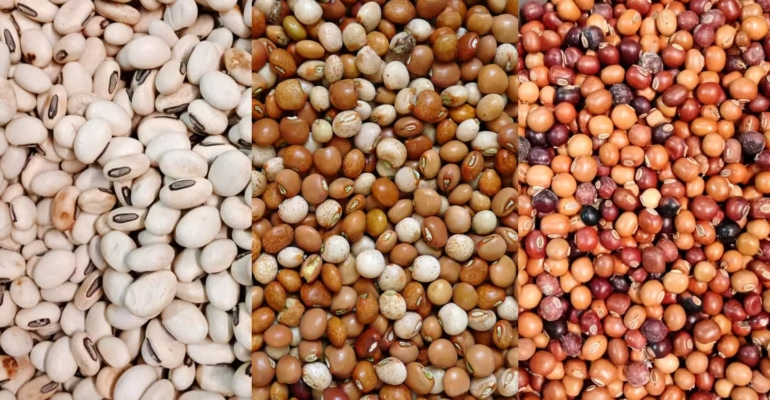
Local beans have the potential to be processed into tempeh as an alternative to soybeans. This development is expected to help reduce Indonesia’s dependence on soybean imports, which currently stand at around 2,5 million metric tons per year.
The development of tempeh made from local legumes, such as koro, gude, and kecipir, can serve as an effort to diversify the food supply while simultaneously reducing Indonesia’s reliance on soybean imports.
Prof Made Astawan, a professor at the Faculty of Engineering and Technology at IPB University and an expert in food biochemistry, explained that scientifically, tempeh is not solely determined by the type of legume used but also by the fermentation process.
According to him, various types of beans can be processed into tempeh using Rhizopus spp. mold inoculum, commonly known as tempeh starter or laru.
“It’s called tempeh if the beans, regardless of the type, fermented with Rhizopus spp. mold inoculum. In layman’s terms, this inoculum is referred to as tempeh starter or laru,” explained Prof Made.
Fermentation Determines the Characteristics of Tempeh
According to Prof Made, the molds involved in tempeh production consist of several species, including Rhizopus oligosporus, Rhizopus oryzae, and Rhizopus stolonifer. In addition to molds, bacteria and yeast can also be involved in the fermentation process, although they play a lesser role.
“In principle, all types of beans can be processed into tempeh,” he emphasized. However, Prof Made explained that differences in raw materials affect the product’s nutritional composition and sensory characteristics.
“Non-soy tempeh generally has a lower protein content, a firmer texture, and a flavor that tends to be less preferred than soy tempeh. According to SNI (Indonesian National Standards), the minimum protein content for tempeh is 15 percent,” he explained.
Soybeans Remain the Ideal Raw Material
Prof Made noted that soybeans remain the most ideal raw material for tempeh because they have the highest protein content and the lowest carbohydrate content compared to other types of beans. The protein quality of soybean tempeh is also nearly equivalent to that of animal protein, but at a more affordable price.
Nevertheless, he believes that local beans have potential for development through food technology innovation. “With various process modifications, Indonesia’s local beans can be processed into tempeh with nutritional composition and sensory acceptance that closely resemble soybean tempeh,” he said. (Fj) (IAAS/EPK)

