IPB University and KOICA Promote Indonesian Bioscience Research through the 2026 NICAB Workshop
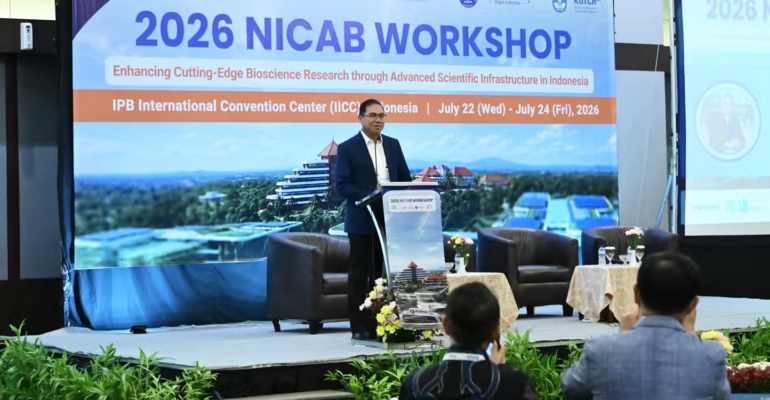
IPB University, in collaboration with the Korea International Cooperation Agency (KOICA), held the 2026 NICAB Workshop at the IPB International Convention Center in Bogor on (7/22).
This event served as a catalyst to accelerate the emergence of agriculture,and bioscience based innovations while supporting the development of a sustainable bioeconomy.
Rector Dr Alim Setiawan Slamet stated that one of the strategic achievements of the collaboration between IPB University and KOICA is the construction of the National Instrumentation Center for Agriculture and Bioscience (NICAB), which is scheduled for completion in February 2027. This facility will serve as a center of excellence for research, innovation, capacity building, and international collaboration in the fields of agriculture and bioscience.
“Once it becomes operational, NICAB will serve as a center of excellence for cutting edge research, innovation, capacity building, and international collaboration in the fields of agriculture and biosciences,” he said.
He added that the development of NICAB aligns with IPB’s vision as a Techno-Socio-Entrepreneurial University that produces innovations with a positive impact on society.
Meanwhile, Prof Tae Sub Park, Deputy Director General of the Institutes of Green Bio Science and Technology (GBST) at Seoul National University (SNU), noted that cooperation between Indonesia and South Korea continues to develop positively.
According to him, this workshop demonstrates the growing strength of the partnership between the two countries in expanding bioscience research and opening up opportunities for interdisciplinary collaboration.
He explained that the development of NICAB, supported by KOICA, along with the provision of advanced research equipment, will strengthen Indonesia’s position as one of the region’s centers for agricultural and bioscience research.
“We hope this workshop will generate new ideas, strengthen scientific collaboration, and open up broader opportunities for joint research between South Korea and Indonesia,” he said.
On the same occasion, the Chairman of the National Research and Innovation Agency (BRIN), Prof Arif Satria, highlighted the importance of building a bioinnovation ecosystem based on Indonesia’s rich biodiversity. He explained that the current development of bioscience has entered the era of the biorevolution, a transformation that leverages advances in biological sciences to generate new innovations across various sectors.
According to Prof Arif, Indonesia has great potential to develop bioinnovation by strengthening research in biodiversity, multi-omics technology, structural biology, and high performance computing.
“All of these stages require world-class research infrastructure so that research findings can be translated into innovative products that benefit society and industry,” he said. (dr) (IAAS/STD)