IPB University Academic Explains the Moon and Saturn Conjunction, a Celestial Event Worth Observing
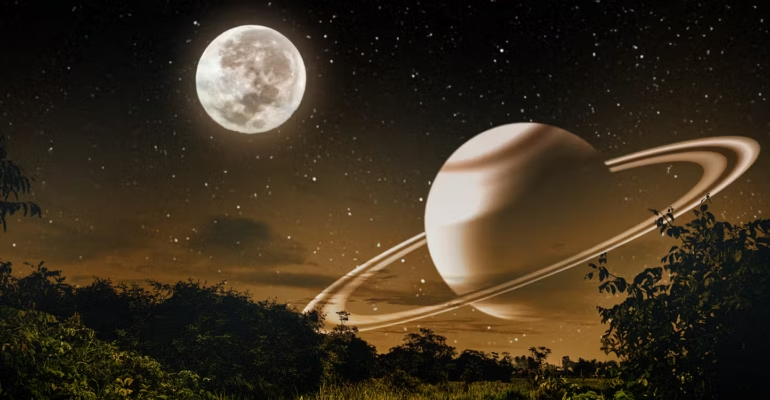
The Moon and Saturn conjunction will grace the night sky on July 8 2026. This astronomical event can be observed with the naked eye, provided the weather is clear and the sky is free from cloud cover.
Izatul Hafizah, M.Si., a lecturer at the Department of Geophysics and Meteorology, IPB University, emphasized that a conjunction is a natural phenomenon that can be scientifically predicted and has no connection to weather changes, earthquakes, or any direct impact on human life.
She explained that, in astronomy, a conjunction occurs when two celestial objects appear very close together as seen from Earth. This apparent proximity is merely a matter of perspective, as the two objects have nearly the same ecliptic longitude, not because they are actually close to one another in space.
“Although they appear close together in the sky, the Moon and Saturn are in fact separated by an enormous distance. The Moon is about 384.000 kilometers from Earth, while Saturn is more than one billion kilometers away. So, a conjunction is simply an effect of the observer’s viewing angle from Earth,” she explained.
She added that no telescope is required to enjoy the event. The Moon will appear as a very bright object, while Saturn will look like a yellowish point of light. However, binoculars or a telescope can provide a better viewing experience, as Saturn’s rings may become more visible.
“This phenomenon can be observed starting at around 11:40 PM WIB when the Moon rises, followed by Saturn at approximately 11:45 PM WIB. The two objects will remain close together throughout the early morning hours until just before sunrise at around 5:52 AM WIB. The best time for observation is when both objects are higher in the sky, between 1:00 AM and 5:00 AM WIB,” she said.
Izatul further explained that the Saturn and Moon conjunction is a natural consequence of the orbital motion of celestial bodies. All planets in the Solar System orbit the Sun on nearly the same plane, known as the ecliptic plane.
Meanwhile, the Moon orbits Earth roughly every 27,3 days, causing it to periodically pass by Saturn’s apparent position in the sky from the perspective of observers on Earth.
She also reminded the public not to associate the phenomenon with claims that lack scientific evidence. According to her, there is currently no scientific proof that a Saturn and Moon conjunction can influence weather conditions, trigger earthquakes, or directly affect human life.
“Weather is driven by atmospheric processes such as solar heating, air circulation, water vapor content, and climate phenomena. Earthquakes, on the other hand, result from tectonic plate movements. The apparent positions of Saturn and the Moon in the sky have no influence on either of these processes,” she said.
Through this event, Izatul hopes the public will use it as an opportunity to enhance their understanding of astronomy and recognize that celestial phenomena can be explained through scientific principles.
She believes that the Saturn and Moon conjunction offers a valuable opportunity to spark curiosity and strengthen public appreciation of science. (dr) (IAAS/KAL)