Director General of Higher Education, Science, and Technology Encourages 49 IPB University Startups to Become National Flagship Products
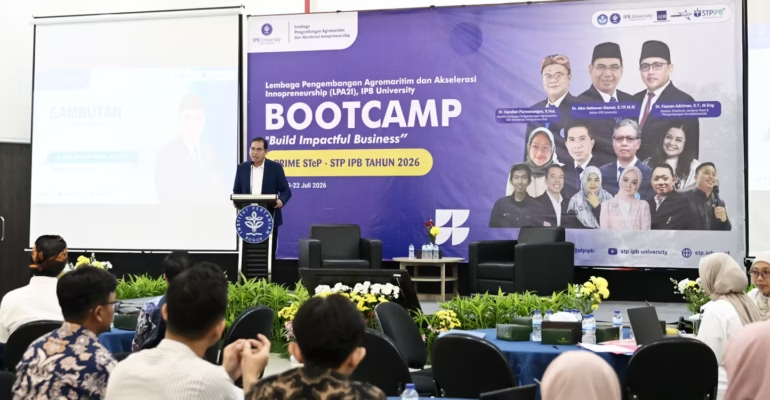
A total of 49 selected startups from the Promoting Research and Innovation through Modern and Efficient Science and Technology Parks Project (PRIME STeP) participated in a bootcamp held at the IPB University Taman Kencana Campus, Bogor (7/20).
The program serves as an important stage in accelerating the downstreaming of research outcomes through business mentoring, network strengthening, and the development of a technology based startup ecosystem.
The Director General of Research and Development at the Ministry of Higher Education, Science, and Technology (Kemdiktisaintek), Dr Fauzan Adziman, encouraged all participants to take advantage of the opportunity to accelerate the development of their innovations into products capable of competing at the national level.
“Congratulations to the 49 startups participating in PRIME STeP. This is a very valuable opportunity. The funding allocated to this program is substantial, so it must be utilized as effectively as possible,” he said in his keynote speech.
He stated that, through the 2026 Indonesian Science, Technology, and Industry Convention (KSTI), the President of the Republic of Indonesia has directed universities to become driving forces of national industrialization, innovation, and economic independence. Therefore, the government continues to seek innovations that have the potential to be developed into national industries.
“We are looking for innovative products that deserve to be elevated nationally and require larger investments in order to grow into industries,” he said.
Fauzan believes that startups should not focus solely on company growth but must also build strong and sustainable business ecosystems. Collaboration with investors is important, but it must be built on a solid business foundation.
He also expressed his appreciation for IPB University’s innovation ecosystem, which he considers one of the best in Indonesia due to its ability to connect research, incubation, and technology based business development.
On the occasion, Fauzan also shared his experience working in industry, becoming an academic at the University of Oxford, and founding a technology-based startup before joining Kemdiktisaintek. According to him, these experiences have equipped him with a deeper understanding of the challenges of research downstreaming in Indonesia.
Meanwhile, the Rector of IPB University, Dr Alim Setiawan, expressed his appreciation to Kemdiktisaintek and the Asian Development Bank (ADB) for their continued support in developing research based startups at IPB University.
According to him, IPB University continues to strengthen its innovation ecosystem so that support for startups does not stop once the incubation period ends.
“We have issued a Rector’s Regulation to build a more sustainable startup ecosystem. Startups that have successfully grown are expected to contribute back to the university, and those contributions will later be used to fund new startups,” he said.
At the same event, ADB representative Theresia Sembiring explained that in 2026, a total of 49 startups joined the program, consisting of 35 startups in the incubation stage and 14 startups in the acceleration stage.
“We are seeing very encouraging progress at IPB University. Collaboration among researchers, students, industry, and investors is becoming stronger in building an innovation ecosystem,” she said.
Theresia encouraged all participants to make the most of the three day bootcamp by expanding their networks, testing their business models, and learning from mentors and industry practitioners.
“Innovation is born from the courage to experiment and learn from failure. Make the most of this opportunity,” she said.
She also revealed that ADB is currently supporting a Science and Technology Park (STP) mapping study in Indonesia to identify the factors that contribute to successful innovation ecosystem development. According to her, the success of research does not end with scientific publications, but when research outcomes are able to deliver tangible benefits to society, create economic value, and give rise to startups that generate employment opportunities.
“At ADB, we believe that startups do not only build companies, but also build solutions, create value, and drive Indonesia’s economic growth,” she concluded. (dh) (IAAS/KAL)