Is It True That Wasps Can Recognize Human Faces? An IPB University Expert Explains the Facts
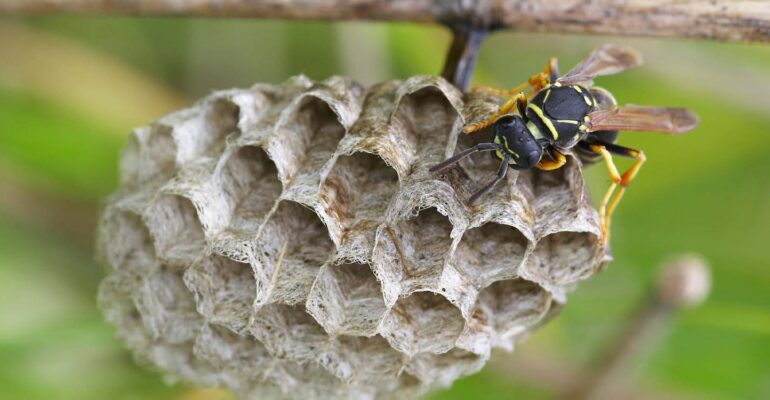
The ability of wasps to recognize human faces has recently been a hot topic on social media. Many people believe that wasps can remember people who have disturbed their nests and will attack them again if they encounter them in the future. So, do these insects really possess this ability?
Prof Tri Atmowidi, an entomologist from the Department of Biology, Faculty of Mathematics and Natural Sciences (FMIPA) at IPB University, explains that wasps’ ability to recognize faces has indeed been proven through a number of studies, although it has only been observed in certain species.
He explained that research conducted by Tibbets and his team at the University of Michigan on paper wasps (Polistes fuscatus) showed that this species has the ability to recognize the faces of other wasps within its colony. This ability involves a fairly complex nervous system and cognitive processes.
“Face recognition in wasps occurs visually through eyes that contain specialized receptor cells. Unlike humans, wasps can see ultraviolet (UV), blue, and green, but cannot see the color red,” he said.
The study, he continued, found specialized nerve cells in the wasp’s brain that play a role in the face recognition process. This visual processing ability also allows wasps to recognize human faces.
“In this species, there are several female queen candidates who compete with one another to become the colony’s queen. Therefore, they need the ability to recognize other individuals in their group. The ability to recognize faces evolved as part of that social need,” he said.
Prof Tri noted that not all wasp species possess this ability. To date, the strongest scientific evidence has been found in paper wasps, which are social insects with complex colony structures.
In contrast, wasps with lower levels of social organization, as well as solitary wasps that live on their own, do not exhibit strong facial recognition abilities because they lack the need to recognize other individuals in detail.
Colony Defense Strategies
Prof Tri added that social wasps, such as paper wasps, also have the potential to remember individuals who have previously disturbed their nests. If they feel threatened, the wasps will exhibit defensive behavior as a form of protection for the colony.
“When the nest is disturbed, wasps can react aggressively and are likely to respond more intensely if they encounter a previously recognized threat again. This ability is a colony defense strategy,” he said.
In addition to relying on vision, wasps also use chemical communication via pheromones. These compounds serve to convey various types of information to colony members, including the presence of threats.
“Paper wasps primarily detect threats through sight, both facial features and movement. Sudden or suspicious movements near the nest can trigger a defensive response. In addition, wasps also use communication pheromones to alert colony members to the presence of danger,” he explained.
Therefore, he urged the public not to disturb wasp nests when they find them in their surroundings. Wasps are inherently defensive and only attack when they feel threatened.
“People should not throw objects at, shake, or set fire to wasp nests. Maintain a safe distance, avoid sudden movements near the nest, and do not use strong-smelling scents when near a nest,” he advised. (AS) (IAAS/KQA)