IPB University, the Central Information Commission, and BNI Encourage the Younger Generation to Become Public Information Literate
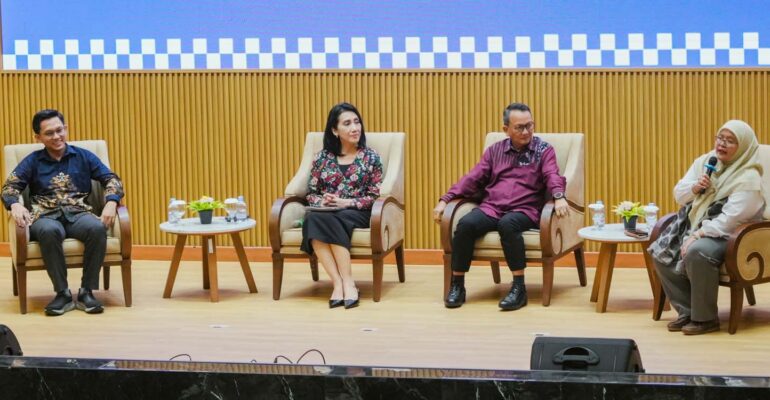
IPB University, together with the Central Information Commission and Bank BNI, held the “Beyond The Classroom” Edutalk program at the IPB Dramaga Campus on Wednesday (5/6). This event reflects a shared commitment to promoting information literacy while strengthening the value of public transparency among the younger generation.
Embracing the spirit of information openness amid the rapid pace of digitalization, this workshop brought together various stakeholders, ranging from government officials to independent institutions.
The Minister of Finance of the Republic of Indonesia, Dr Purbaya Yudhi Sadewa, in his remarks delivered via a pre-recorded video, expressed appreciation for the event’s organization.
“I warmly welcome this educational initiative on information openness as a crucial opportunity to instill the values of transparency and public information openness, particularly among the younger generation. Through a solid understanding, we hope to foster a generation that is critical, participatory, and of high integrity in safeguarding public information,” he stated.
Meanwhile, the Rector of IPB University, Dr Alim Setiawan Slamet, highlighted the major challenges facing the younger generation amid global disruption. Referring to a World Economic Forum report, he noted that approximately 22 percent of jobs are projected to be affected by disruption by 2030, while 170 million new types of jobs are expected to emerge.
“The issue is no longer about access to information, but rather the ability to process and utilize it. We have entered an era of the democratization of knowledge, where anyone can learn from anywhere, including through various global platforms,” he explained.
He added that IPB University continues to promote an interdisciplinary approach in education. One example is the Bioinformatics program, which integrates biology and computer science, as well as the use of technologies such as artificial intelligence, sensors, and drones in the agricultural sector.
“Moving forward, what is needed is not just a high GPA (cumulative grade point average), but also adaptability, collaboration, creativity, and leadership. Students must become lifelong learners, not merely memorizers of material,” he emphasized.
On the same occasion, Samrotunnajah Ismail, SE, MSi, Commissioner for Advocacy, Outreach, and Education at the Central Information Commission, highlighted the challenges of information literacy in the digital age. She stressed that the flood of information must be balanced with strong verification skills so that the public is not easily exposed to misinformation.
“Today’s youth are not merely consumers of information but also producers. Therefore, it is crucial to possess information literacy skills to distinguish between accurate information and misleading content,” she explained.
During a talk show hosted by the Director of Career Development, Entrepreneurship, and Alumni Relations, Puji Mudiana, SP, MA, strategies for honing non academic potential in the era of open public information were discussed.
The Director of Cooperation, Communication, and Marketing at IPB University, Dr Alfian Helmi, emphasized that success is no longer measured solely by academic standards. “Future competition isn’t just about knowledge, but also creativity, imagination, and the ability to think independently. Integrity and a balance between idealism and pragmatism are key,” he stated succinctly.
From the industrial sector, Deputy Director of Stakeholder Engagement & Sustainability at APRIL Group, Dian Novarina, highlighted the importance of building a sustainable career amid change. “Success is not determined solely by hard skills, but also by character, adaptability, and integrity. Leadership is earned through action,” she explained.
Meanwhile, Rahmat Pertinda, General Manager of the CX Center Division at Bank BNI, emphasized the importance of protecting personal data in the digital age. “Never share OTPs, PINs, or card details with anyone. Vigilance and discipline in safeguarding data are key to preventing digital crime,” he stated.
Through this initiative, all parties hope that the younger generation will become active agents of change in promoting transparency, both on campus and in the wider community. Cross sector collaboration is seen as key to creating an information ecosystem that is open, credible, and impactful. (AS) (IAAS/KQA)