IPB University and Astra’s ‘OVOC’ Campus Impact Program Boosts Farmers’ Incomes by Up to 108 Percent and Opens the Door to Exports
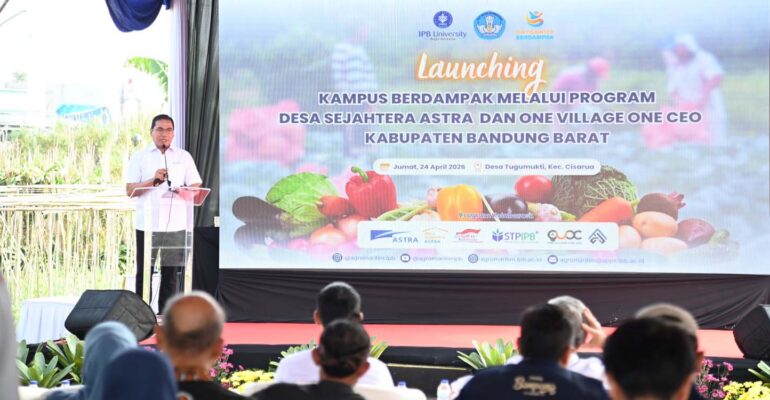
IPB University, in collaboration with PT Astra International Tbk, launched the Campus Impact Program through the One Village One CEO (OVOC) and Astra Prosperous Village initiatives in West Bandung Regency. This program integrates research, innovation, and community empowerment to improve village welfare and open market access, including for exports.
IPB University Rector Dr Alim Setiawan Slamet emphasized that this program aligns with the policy direction of the Ministry of Higher Education, Science, and Technology (Kemdiktisaintek). “The priority is on developing impact driven campuses so that more benefits can be derived from the research and innovation produced by universities,” he said.
He explained that IPB champions the vision of an Techno-sociopreneur University by promoting the commercialization of innovations in villages to generate economic value for the community. The OVOC and Astra Prosperous Village programs serve as platforms for implementing these innovations through direct on site mentoring.
This program also receives support from the local government. The Vice Regent of West Bandung, H Asep Ismail, stated that the expansion of this program to other areas is eagerly anticipated. “We highly appreciate this Impact Campus initiative. It is time for universities to return to the community and provide tangible solutions,” he said. He added that similar programs are now awaited for implementation in the other 164 villages in West Bandung.
From an industry perspective, Diah Suran Febrianti, Head of Environment and Social Responsibility at PT Astra, emphasized the importance of multi stakeholder collaboration as well as the resulting economic impact. “Farmers’ incomes have increased by up to 108 percent, from around Rp1,2 million to Rp2,5 million per month,” she said.
Specifically, this program has managed 20 hectares of horticultural land with productivity reaching 2 tons per day or 60 tons per month. Approximately 400–650 community members are involved, and 250 jobs have been created. Horticultural products are fully absorbed by the market and have penetrated the export market to Singapore.
Director of Talent Development for Research and Development at the Ministry of Education, Culture, Research, and Technology Kemdiktisaintek, Prof Heri Kuswanto, views this program as an ideal model of collaboration. “Community service and research programs must be grounded in real world community challenges,” he stated.
The implementation of the OVOC program introduces technological innovations directly applied in the field. One such innovation is post harvest ozonation technology to suppress microbes and reduce pesticide residues, thereby better preserving product quality. Additionally, ozonation extends the shelf life of horticultural commodities from approximately one day to up to five days, thereby reducing potential losses for farmers.
Upstream, farmers also use automatic weather stations (AWS) to monitor real time weather conditions, such as temperature, rainfall, and humidity. This data helps farmers determine the optimal timing for planting, fertilization, and harvesting, thereby increasing productivity and reducing the risk of crop failure.
Muhammad Taufik, a horticultural farmer in Tugu Mukti village, said he has experienced the direct benefits of these innovations. “With ozonation, pesticide residues can be reduced and the shelf life of products can be extended. The AWS also helps us read the weather more accurately,” he said.
At the conclusion of the event, Dr Alim emphasized that the success of this program depends on sustained collaboration. “This is a pentahelix collaboration between academia, government, the business sector, and the community. We will continue to develop this model in various regions,” he said. (Fj) (IAAS/LAN)