IPB University Innovator Transforms Pressure Cooker into Food Sterilization Device, Included in 117 Indonesian Innovations
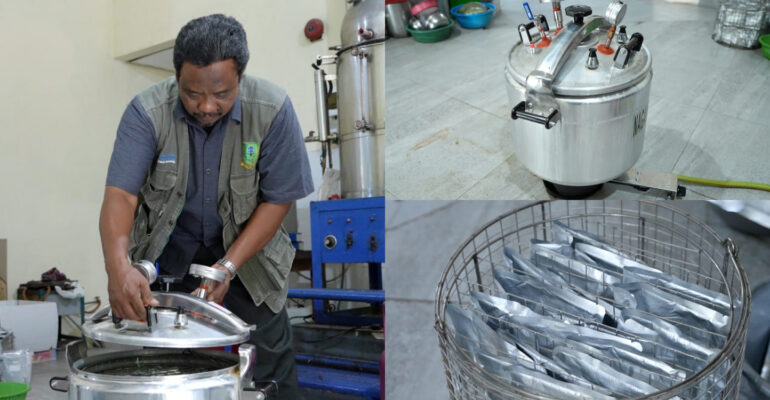
A food product sterilization device based on a pressure cooker developed by IPB University innovator Dr Tjahja Muhandri has been included in the list of 117 Indonesian Innovations by the Business Innovation Center (BIC) in 2025.
The device was designed to assist small industries in producing sterile packaged food that meets distribution permit standards from the Food and Drug Supervisory Agency (BPOM).
Dr Tjahja explained that the device is a modification of a pressure cooker commonly available on the market. The development involved adding several important components so that the sterilization process can meet food production standards.
“This device is produced in collaboration with PT Rubyval Berkat Validitas. It is a modification of a pressure cooker available on the market with the addition of a thermometer, pressure gauge, steam release valve, and a basket for holding the products,” he said.
According to him, the device can be used to produce food products with a level of commercial sterility, enabling them to meet BPOM requirements for distribution permits.
He explained that many small packaged food industries have difficulty obtaining distribution permits from BPOM. One of the causes is the lack of compliance with good manufacturing practices (GMP) in the production process, particularly at the stage of sterilizing packaged food products.
This innovation develops a food sterilization process by modifying a commercial pressure cooker with a capacity of 50 liters. In addition to adding a basket to hold products during the sterilization process, the modification also aims to ensure even heat distribution.
The sterilization device has been tested safely at a temperature of 110°C, which is the maximum working temperature of commercial pressure cookers under normal conditions. The sterilization process only requires a household gas stove as the heat source.
In terms of cost, the device is considered more competitive compared to other commercial sterilization systems that require steam sources and boilers. In addition, some commercial equipment cannot necessarily guarantee uniform heat distribution during the sterilization process.
Dr Tjahja noted that the potential use of this innovation is quite significant, in line with increasing market demand for traditional Indonesian foods packaged in a form that allows longer shelf life and distribution to various regions.
Moreover, the innovation also has the potential to support the processing of sacrificial and aqiqah meat into packaged food products with extended shelf life, enabling distribution to other regions or disaster affected areas.
“This innovation can also be utilized for the production of ready to eat packaged food as food reserves during disasters,” he said. (dh) (IAAS/KAL)