
Department of MSP IPB University Reviews the Coherence of Harvest Strategy and Ecolabelling
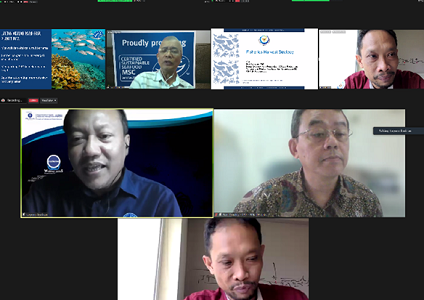
Department of Aquatic Resources Management (MSP), Faculty of Fisheries and Marine Science (FPIK), IPB University held a Webinar Series themed 'Coherence of Harvest Strategy and Ecolabelling in Demersal and Crustacean Fisheries Governance to Support Blue Economy'.
"This webinar is one of the series leading to the peak of the International Seminar on Demersal and Crustacean Fisheries Management (ISDCFM 2023) which will be held on August 2-3, 2023," said Dr M Mukhlis Kamal, chairman of the webinar committee.
Prof Hefni Effendi as the chairman of the MSP Department of IPB University hopes that this activity can become a tower of knowledge for various stakeholders to participate in contributing their aspirations in the field of fisheries. This webinar is also a forum for students as the younger generation to develop their creativity.
On this occasion, the Dean of FPIK IPB University, Prof Fredinan Yulianda, said that fishery resources are one of the important commodities in the world. This is because 70 percent of the earth's surface is sea.
"But unfortunately, Indonesian fisheries have not been able to be utilized optimally, one example is the lack of prosperous coastal communities. That's why the term blue economy was introduced as a concept of sustainable resource utilization, both in terms of ecology and economy," he explained.
Dr Taryono, lecturer at the MSP Department of IPB University said that this activity could be a forum for learning and new insights in the world of fisheries. The topic of harvest strategy and ecolabelling strongly supports the blue economy program. In many definitions, the blue economy is an economy that is driven by ocean resources.
Gadjah Mada University lecturer, Dr Suadi, said that blue economy is the health of the aquatic environment that is maintained and can make fisheries communities prosperous with high production. Blue economy can include marine ecosystem, marine biodiversity, aquaculture and marine economy.
Dr Suadi also explained about blue swimming crab, which is a big business and has a relatively large value in Indonesia (commodity-based). Currently, Indonesia is a large crab producer with marketing levels up to America and Europe.
"The trend of crab demand in general is starting to increase with positive growth. The data needed are reproductive biology, fishing gear, catch per unit effort (CPUE), sustainability and management. This data determines the reference point needed to make a harvest strategy," he continued.
On the other hand, Dr Fery Sutyawan from the Directorate of Fish Resource Management, Ministry of Maritime Affairs and Fisheries (KKP) said that his party is trying to develop a harvest strategy as one of the efforts to manage fisheries. Indonesia has 11 fisheries management areas
"KKP is mandated to make a harvest strategy in each WPP within five years. However, until now there has not been one harvest strategy realized. The reference given by the KKP to fisheries business actors is the Spawning Potential Ratio (SPR) of a maximum of 20 percent," he said.
Dr Fery mentioned that biological data related to length and weight and the uneven location of data collection samples are obstacles in the process of preparing a harvest strategy. KKP hopes that with the harvest strategy, the potential of fisheries in Indonesia will be more sustainable and can recover faster.
In addition, the current challenge of the world's oceans is that fish stocks are declining due to the increasing level of global fish consumption. Hirmen Sofyanto, Program Director of the Marine Stewardship Council (MSC), explained that there are three aspects related to sustainable fisheries management: maintaining habitat, balancing catch and restock from nature and ensuring fishing activities do not damage the ecosystem.
"Every year MSC conducts a survey on the global fish consumption outlook. The results show that overfishing is a hazard and main concern in world fisheries in addition to climate change and pollution. MSC is present to provoke fisheries in the ecolabel and fisheries certification program and also efforts to support sustainable development goals (SDGs) 14," he explained.
At the event, Prof La Sara, a lecturer at Halu Oleo University also emphasized the importance of realizing the 1945 Constitution in the field of fisheries. This is so that fisheries resources can be utilized as well as possible and maintained sustainably. (IAAS/RUM)

