
IPB University Launches Three Innovations of Excellent Research Results on Palm Oil 4.0
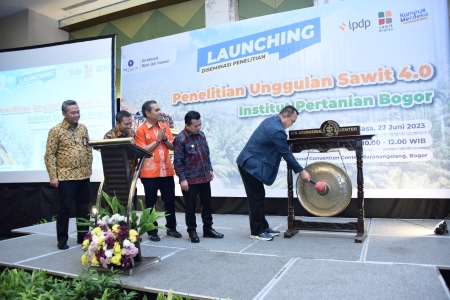
IPB University through the Directorate of Research and Innovation (DRI) and the Directorate of Agromaritime Community Development (PMA) held a Launching of IPB’s Excellent Research Results: Palm Oil 4.0. In this activity, IPB University launched three palm oil innovations namely GREEN FAST IPB, OPTIMAL IPB and SIPESAT IPB.
GREEN FAST IPB is an environmentally friendly fashion creative industry product innovation based on biomass, namely oil palm empty fruit bunches (TKKS). This product is also low in emissions because the raw material used is palm biomass which is produced without chemicals and has economic value and competitive prices in the market.
Rector of IPB University, Prof Arif Satria in his speech said, agromaritime products are not only about food but also about biomaterials. “The future is determined by research in biomaterials. The clothes that we know so far come from cotton, can now be made from palm oil waste,” he said during the launching event at the IPB International Convention Centre (IICC), Bogor (27/6).
Prof Arif added, the existence of this green fashion further strengthens the circular economy, that all waste from various plantation products can be processed for various things. For example, palm oil waste can be made into helmets, bulletproof vests and sugar production.
“This can certainly be an inspiration for further findings in the future. IPB University will continue to encourage innovators to be able to produce their work to support the progress of the Indonesian nation,” he said.
IPB’s Oil Palm Identification Based on Machine Learning (OPTIMAL) innovation was developed as an object-based mapping model, in this case a stand of oil palm trees. This innovation is able to detect oil palm objects in high-resolution satellite images based on deep learning models. OPTIMAL IPB can be utilised to map smallholder oil palm plantations throughout Indonesia.
Jambi Province Governor, Dr H Al Haris, said that the absence of a map of smallholder oil palm plantations has made the government’s efforts to encourage improvements in the cultivation of smallholder oil palm plantations ineffective.
“The mapping model currently developed by IPB University through research funded by the Education Fund Management Institution (LPDP) is very potential to answer this need, so that the programmes of the Jambi Provincial Government in increasing the competitiveness of smallholder oil palm plantation production can be carried out effectively and efficiently,” he said.
Heru Tri Widarto, SSi, MSc, Secretary of the Directorate General (Sesditjen) of Plantations, Ministry of Agriculture, added that the characteristics of smallholder oil palm are spread, small, uneven and far from access. Therefore, according to him, OPTIMAL IPB can be utilised for data collection of smallholder oil palm to be more precise and planned. Thus, the Ministry of Agriculture can maximise the uptake of smallholder oil palm replanting activities from the Palm Oil Plantation Fund Management Agency (BPDPKS).
Another innovation launched was IPB’s Information System for Performance Assessment and Institutional Strengthening of Palm Oil Supply Chain (SIPESAT). This information system is useful for performance assessment and institutional strengthening of the oil palm supply chain of independent smallholders. Along with the development of digital technology and industry 4.0, supply chain performance and institutions need to be implemented in an adaptive system that is able to reach all actors in the supply chain.
The Director of Research Facilitation of the Education Fund Management Agency (LPDP), Ir Wisnu S Soenarso, MEng hopes that IPB University together with the Indonesian Ministry of Agriculture and the Jambi Province Plantation Office as partners can consistently maximise the products of this research as an improvement in palm oil management governance policies in the future. (Ns/Rz) (IAAS/RUM)

