
Collaboration between RASSEA, GFRAS, FEMA IPB University and PAPPI Holds The 3rd Regional Virtual Meeting on Digital Innovation in Agricultural Extension in Southeast Asia
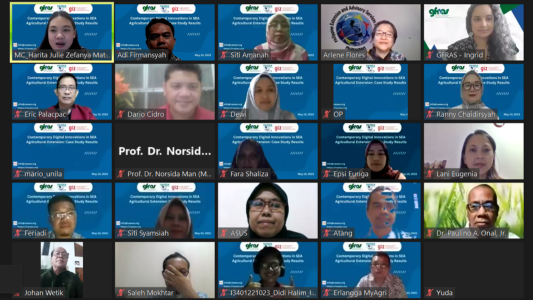
Rural Advisory Services for Southeast Asia (RASSEA) in collaboration with the Global Forum for Rural Advisory Services (GFRAS) organised the 3rd Regional Webinar which aims to share study results on contemporary digital innovations in agricultural extension in Southeast Asia. The seminar was also supported by the Faculty of Human Ecology (Fema) IPB University and the Indonesian Association of Development Extension Experts (PAPPI).
"The aim of this research is to gain a better understanding of digital solutions at work in the regions of Indonesia and the Philippines. Both challenges, potentials and future recommendations for all actors to support RAS. This study is also intended to promote digital-based RAS," said Ingrid Oliveira, a representative from GFRAS in her opening remarks.
The study team was led by Dr Siti Amanah, a lecturer at Fema IPB University. During the event, she explained that the rapid development of information communication technology (ICT) also has an impact on the agricultural sector.
"This (ICT) development has changed the strategy in the agricultural sector, especially in terms of increasing the knowledge and skills of farmers or producers so that they can produce quality and competitive products," said the RASSEA Chairperson.
According to her, the agricultural extension approach has transformed from a process that requires full support from extension workers to a very independent extension, where farmers seek and obtain information with the support of information technology.
Dr Ranny Mutiara, a member of the RASSEA study team presented lessons learnt from an Indonesian case study, My Agri, a Digital RAS application focusing on horticulture. She revealed key findings that explored user characteristics and dynamics, services and benefits, current business models, RAS impacts and challenges.
"Digital agricultural extension offers great potential to help farmers, extension agents and other users with access to real-time information, including on-farm and off-farm solutions.
On the other hand, she mentioned the challenges and constraints ahead are related to service improvement, including institutional issues, technical aspects such as accessibility, human resource (HR) capacity building and sustainability (such as business model development, financial plans, technology & service innovation and political will).
Dr Arlene Flores, a member of the study team from the Philippines presented lessons learned from her country's case study, The Rice Crop Manager Advisory Services (RCMAS), a tool integrated into one digital platform.
"The result of the RCMAS case study is that digitally supported extension/RAS provides benefits, usability, recognition of performance and encourages inclusive development for farmers and implementers," he said. The challenges that need to be overcome to support digital transformation in digital-based agricultural extension in the Philippines are not much different from the My Agri case study in Indonesia.
The formulation of the webinar results in the form of a strategic framework for the future to promote Digital RAS was presented by RASSEA study team members Lani Eugenia and Dr Epsi Euriga. The points of the formulation include multi-stakeholder awareness, human resource capacity building on technology, ICT infrastructure, government support and financing.
Also attending the webinar were Dr Rani Mutiara (Indonesia) and Dr Arlene Luna Flores (Philippines). The discussion was facilitated by moderator, Dr Eric Palacpac, Head of Knowledge Management Division, Department of Agriculture – Carabao Center Philippines who is also President of the Philippine Extension and Advisory Services Network (PhilEASNet). (*/Rz) (IAAS/RUM)

