IPB University Launches PENA, a Model for Calculating the Value of Losses and Damage in the Agricultural Sector Due to the Cianjur Earthquake
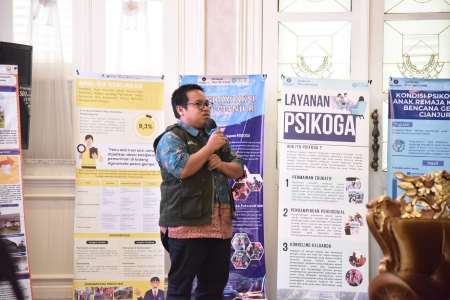
At the launch of the research results held by the Directorate of Research and Innovation (DRI), IPB University launched PENA as a model for calculating the value of losses and damage to the agricultural sector due to the earthquake in Cianjur Regency, (30/3). Through the Action Research program, PENA is a collaboration between DRI and the Department of Resource and Environmental Economics (ESL), Faculty of Economics and Management (FEM).
Dr Kastana Sapanli as the head of the research team said, regarding the large value of losses and damage to the agricultural sector due to the earthquake in Cianjur Regency, this study recommends policies that can be implemented in the short and medium term.
"The form of short-term recommendations is trauma healing for farmers, repair of affected agricultural infrastructure and assistance with agricultural production facilities," he said.
Meanwhile, recommendations in the medium term can be made by strengthening farmer institutions based on disaster response, increasing diversification of agricultural products, implementing smart farming, and strengthening digital-based agricultural supply chains. This was done as a form of reconstruction for the people of Cianjur Regency, especially the farmers.
"Therefore, through PENA and policy recommendations, IPB University hopes to contribute to accelerating efforts to recover the agricultural sector after the earthquake in Cianjur Regency," he said.
Members of the research team consisted of Dr Ahyar Ismail, Dr Nuva, Danang Pramudita, SP, MSi, Iqbal Ramdani, Sahaya Aulia Azzahra, Fikri Aldi Dwi Putro, Nabila Nur Septiani, Genadi Zuhdirabbani, Aditya Handoyo Putra, Surya Dwi Arifin and Dandi Rivaldi Sudrajat.
This action research also collaborated with several agencies such as the Food Crops, Horticulture, Plantation and Food Security Agency for Cianjur Regency, the Agricultural Extension Agency for Warungkondang District, the Agricultural Extension Agency for Cugenang District, and the Regional Disaster Management Agency for Cianjur Regency.
As is known, an earthquake with a magnitude of 5,6 in Cianjur Regency caused losses to the agricultural sector, such as food crops, horticultural crops, livestock, to agricultural facilities and infrastructure. In fact, according to West Java Central Statistics Agency (BPS) data for 2022, Cianjur Regency is one of the areas with the largest harvested area and rice production in West Java Province. In addition, the earthquake also caused damage to agricultural land, decreased productivity, and the sustainability of farming.
"Damage to agricultural facilities and infrastructure such as rice mills, saprotan to irrigation has caused the agricultural production process to stop. In addition, some farmers have not yet returned to work on their land due to post-earthquake trauma and frequent aftershocks," said Dr Kastana.
He said, if this continues, these conditions will threaten the supply chain and rising food commodity prices. "Therefore, PENA's calculation model can help calculate losses and damage due to earthquakes. Later, several policy recommendations can be made for a post-earthquake recovery strategy in Cianjur Regency.”
The total value of damage to the agricultural sector due to the earthquake in Cianjur Regency was Rp26,17 billion, with the largest component due to shifts in paddy fields and landslides. This calculation is estimated from the standard market price of land and the cost of rice fields preparation. Meanwhile, the total losses in the agricultural sector due to the earthquake in Cianjur Regency reached IDR 963,53 million in the two sub-districts, which were estimated from the loss of farming income per planting season due to damaged land or land used for evacuation.
Cugenang District, as the epicenter of the earthquake in Cianjur Regency, had a greater loss of Rp. 860,31 million compared to Warungkondang District, which was Rp. 103,22 million. In general, the damage caused to the agricultural sector has decreased farmers' income by 11,44 percent. (*/Rz) (IAAS/DSR)