Cerdas of IPB initiates Climate Adaptation at Lake Tempe
Center for Disaster Studies (Cerdas) of Institute for Research and Community Services (LPPM) of Bogor Agricultural University (IPB) continues to encourage and strive to increase public awareness of disasters on land, coastal, marine and fresh water such lakes.
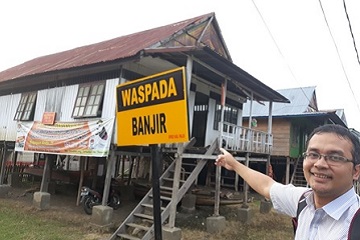
Secretary of Center for Disaster Studies of LPPM of IPB, Perdinan, PhD, MNRE initiated this action in Lake Tempe. This lake, which is located in South Sulawesi or about 3-4 hours from Makassar city, is one of the old lakes and becomes a national priority. The problems in Lake Tempe are complex, such as the increase of sedimentation, decrease of quantity and quality of water, and the occurrence of flooding in the vicinity of the lake.
"In the problems we found, we will find a strong correlation between social character of society and climatic conditions if we examine more deeply. This reason then became the background for the Center for Disaster Studies of LPPM of IPB to encourage the growth of climate understanding and awareness in managing the area. For example, during the rainy season Lake Tempe and the surrounding lakes (ie: Lake Sidenreng and Lake Buaya) become one unit of water (flooded area) which hinders various community activities such as agricultural activities, which leads to the losses," he said.
The initiation of climate adaptation was begun by identifying existing problems in Lake Tempe by the Center for Disaster Studies of LPPM of IPB together with Directorate of Adaptation of Directorate General of Climate Change of Ministry of Environment and Forestry (DIRJEN PI KLHK). Climate change has significantly affected the changes in the rainfall of Lake Tempe area which then causes the flood.
This adaptation activity was conducted through a focused dialogue (FGD) with the community which was opened by the Director of Adaptation of DIRJEN PI KLHK, Sri Tanri Arundati, MSc. Sri Tanri emphasized the need for planning a good management in Lake Tempe that is adaptive to the potential impacts of climate change in the future.
Participants of the dialogue came from diverse related agencies and authorities. They provided information on various issues, especially sedimentation, reduction of fish species, and the need for consideration in actions, for instance, to keep weeds of about ten percent as fish feed. The initiative to form a working group was also initiated by considering the complexity of the problems and the need for coordination of various parties so that the activities are right on target.
Climate adaptation in the management of Lake Tempe was aimed to encourage the mainstreaming of climate change issues in the management of the lake. Perdinan, PhD, who is a doctorate graduated from Michigan State University and lecturer in the Department of Geophysics and Meteorology IPB, expressed the need for information on climate change projection. Utilization of climate change information can provide an overview of future climatic conditions and can be used as an instrument to predict changes in flooded area and sedimentation rate of Lake Tempe.
The estimation of potential impacts of climate change can then be used in the preparation of Lake Tempe management plans involving various parties. In this forum the process of forming a Working Group (POKJA) was also revealed. This working group is directed to arrange road map of lake management with action strategy that has direct impact to community's life. Through this adaptation process, it is hoped that awareness of the risks and impacts of disasters from the climate will become communal awareness, thus minimizing losses from disasters that may occur. (red/ZSP/Zul).