IPB Student: Biophysical Environment Affect the Spreading Pattern of Castanopsis in Galunggung Mountain
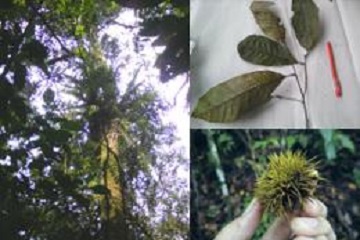
Mount Galunggung is the type A active volcano, it is located in northwest of Tasikmalaya City, West Java. Its areas are covered by tropical rainforest ecosystem type and highland forest in Java Island. This mountain lands provide a scattered but diverse array of habitats in which a large range of plants and animals can be found. One type of typical highland trees, especially on the island of Java is Castanopsis javanica, the Javan chestnut-oak or Ki hiur, is a tree in the beech family Fagaceae.
The student of the Department of Silviculture, of the Faculty of Forestry, Bogor Agricultural University (FAHUTAN IPB), namely Rani Nur Cahyani, successfully analysed Castanopsis distribution pattern in Galunggung Mountain Forest. Her research was on "Pola Penyebaran dan Karakteristik Tempat Tumbuh Castanopsis javanica dan Castanopsis tungurrut di Hutan Gunung Galunggung Tasikmalaya (The Distribution Pattern and Characteristics of the Growing Place of Castanopsis javanica and Castanopsis tungurrut in Galunggung Mountain Forest, Tasikmalaya, Indonesia)", under the supervision of Dr. Iwan Hilwan.
Rani said the tree species from the castanopsis genus is one of the timber trees, also produces non-timber forest products in the form of consumable fruits. Castanopsis javanica is an evergreen tree growing 10 – 40 metres tall. The bole, which is sometimes fluted, is 20 – 100cm in diameter. The tree yields a durable timber that is used locally. It is cultivated locally in Java for the production of its edible nuts. The nuts of several species are eaten raw, cooked, roasted or are used in chocolates and pastries. The bark or the heartwood sometimes yields tannin and rarely also a dye. The twigs are used for mushroom cultivation. This is one of many timber-bearing species in the genus Castanopsis that is harvested from the wild on a commercial basis and traded under the name Berangan. Because of the many benefits that Castanopsis has, it will encourage this type of plant management activities, so that information on the pattern of dispersal, regeneration, and the characteristics of the growing place is needed.
In his research, the plots used to retrieve the data were combination of paths with lines ticked at three different heights i.e. 1300 m, 1400 m, and 1600 m above sea level. Data analysis used were vegetation analysis, soil analysis, and relationship analysis between biophysical environmental factors to the existence of Castanopsis.
Rani's research revealed that the types of Castanopsis found in the study sites were C. javanica and C. tungurrut. The results showed that C. javanica and C. tungurrut had different dispersal patterns at each altitude. C. javanica clumped significantly at altitudes of 1,600 mdpl and clustered insignificantly at two other altitudes, whereas the uniform C. tungurrut dispersal pattern was significantly at 1300 m above sea level and clumped significantly at 1,400 m altitude and 1,600 m above sea level.
"Natural regeneration of berangan is very poor; seeds are readily attacked by insect larvae or by fungi and may be eaten by animals. Although seedfall is profuse in mountainous areas of Java, the maximum number of seedlings 15 months after seedfall is no more than 16 per 100 m2. Natural regeneration cannot develop in artificial gaps of 1000-3000 m2, but in gaps smaller than 1000 m2 seedlings may develop and the young trees attain 10 m in height 12 years after cutting. For the potential of regeneration of Castanopsis in the three research sites it is considered unfavorable because the regeneration of each type of Castanopsis is not present at every altitude. However, C. javanica has a better regeneration potential than C. Tungurrut, "Rani said.
Rani added, biophysical environment (climate, grazing and water resources) of the study area as observed that significantly affect the density of Castanopsis is the height or altitude above the sea level of the location. In addition, soil fertility does not affect tree height of this type of Castanopsis. (Wied)