
IPB Held FGD to Improve the Governance of Indonesian Food Production
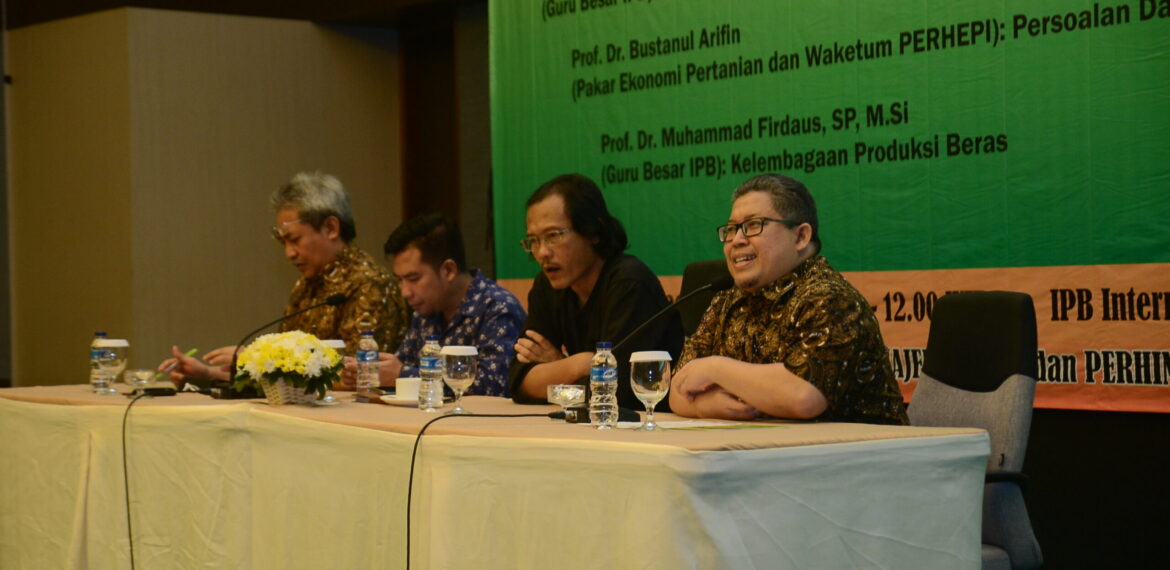
Faculty of Economics and Management (FEM), Bogor Agricultural University (IPB), held the Focus Group Discussion (FGD) to “Membedah Tata Kelola Produksi Pangan Indonesia / Dissecting the Governance of Indonesian Food Production”. The FGD in collaboration with the Indonesian Agricultural Economy Association (Perhepi) took place in the IPB International Convention Center (IICC), Bogor (26/2). The event that was officially opened by Vice Rector for Information System of IPB, Prof.Dr. Dodik Ridho Nurrochmat, was attended by a number of experts, practitioners, students, and also elements of government.
Present a number of panelists in the FGD namely Professor of IPB, Prof.Dr. Dwi Andreas Santosa, who described the production technology and the postharvest handling; Expert of Agriculture Economics and Vice Chairman of Perhepi, Prof.Dr. Bustanul Arifin, which discussed the rice data; as well as Professor of IPB, Prof.Dr. Muhammad Firdaus, who spoke of the institutional production of rice. Prof. Dodik conveyed, related to the implementation of the food production governance needed more effort, especially in terms of the data repair. Technically, it should be improved along with the method used, who would take the data. Second, the implication of the policy. In various discussions, the problem of the data repair was not easy implication.
“Our data are indeed not true, the problem of data correctness must be equally we uphold. The errors of data especially the food have occurred since 1990s. Nowadays, it is increasingly exponentially. We do not need to blame each other, but it must be synergized, so that the better is to the future, complement each other and complete. The purpose is for the welfare of the people and the prosperity of the Indonesian nation,” he added. In his presentation, Prof. Andreas said that currently 76.6 percent of farmers in Indonesia were including the smallholders, i.e. the small farmers with the small land area. The farmers’ welfare over the past 16 years tended to decline. Indonesia had stagnated the rice production from year to year.
“The three most important technological sequences according to the farmer’s perception are the seed and the seed technology, the fertilizer and precision system, as well as the pest and disease control technology. The proposed solution is the seed good fortune movement, the fertilizer technology and the precision farming, as well as the farmer’s technological house. The people’s movement for the food sovereignty is trying to enter the marketing aspect to cut the production chain, which sells the smallholder product,” said Prof. Andreas.
Meanwhile, Prof. Firdaus explained, the rice in the food prices in Indonesia was still dominantly caused by the "scarcity of supplies ". For many cases, in certain months the production experienced the scarcity including the rice (December-January).
"The problem of the rice distribution system is that the rice distribution line is still relatively long. The price variation in the farmers is still large with a weak bargaining position. The cost structure of production has shown a gain in the rice farming, although it is high. The rice distribution cost shows an uneven margin among the market participants. The highest margin is with the retailers. The market integration between the producers and wholesalers is healthier than the producers with the retailers. One of the most important problems in rice is the bigger rice gap," said Prof. Firdaus.
Therefore, Prof. Firdaus provided a view of the need for the improvement from the institutional side of rice. One of the articles in Law (UU) No. 18/2012 chapter 126 which read: "In terms of realizing the food sovereignty, the food self-sufficiency, and the national food security, it is formed the government institution that handles the field of food under and responsible to the president."
“Should have formed the Food Agency for Rice in November 2015. But unfortunately until now it has not been formed,” said Prof. Firdaus.
He said, the initial task of the Food Agency for rice was to stipulate the production figure, the consumption of Indonesian rice; to formulate the rice stock management strategy in the community, the central government, the regional government and the private; to prepare the rice information system tools; to make the dash-board of the food security, because until now Indonesia did not have the dash-board of the food security; and to manage a just rice distribution system; as well as the export and import regulations. (RJ/nm)

