
Acceptance of New Students of Institut Pertanian Bogor for 2018
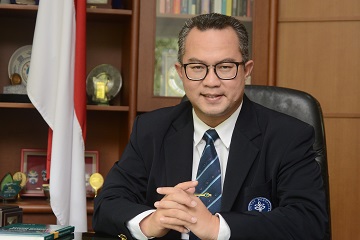
The quality of prospective students is one of the important factors to produce graduates who meet high competency standards and are able to compete at national and global level. "Therefore, Bogor Agricultural University (IPB) always strives to get the best students through the selection mechanism of new student candidates, by innovating in the selection of new students," said the Rector of IPB, Dr. Arif Satria.
In 1976, IPB was one of five pioneer universities for SKALU program or Sekretariat Kerjasama Antar Lima Universitas (Secretariat of Inter-Five Cooperation University). Then in 1979, IPB also became one of the pioneers in the selection of students without a test through the Pioneer Project II with Indonesia University (UI), Gadjah Mada University (UGM), and Bandung Institute of Technology (ITB), where the university selection process was implemented through high school grades. The selection mechanism through the grades of High School students rapor (report card on the scores they earn) has now been made as one of the national selection patterns known as the Seleksi Nasional Masuk Perguruan Tinggi Negeri (SNMPTN National Selection of State University Entrance) after experiencing some name changes.
Further the Rector explained that many universities have developed independent selection which is often evaluated as an effort to increase the income for universities, in 2003 IPB started to develop a scheme of Beasiswa Utusan Daerah (BUD Regional Representative Scholarship). It is a mechanism to find the best student candidates from various regions in Indonesia under the financial scheme of Local Government or private and other institutions. The BUD mechanism is expected to lower the financial burden to be shouldered by students, and after completing their studies, they will return to their respective regions to assist the local government in developing the region.
Research programs have revealed that the number of students offering agriculture courses and agricultural related programmes at the secondary and tertiary levels has been declining annually. The major factors that demotivate students to study agriculture include issues of poor employment prospects and the negative perceptions about agricultural jobs. Despite the decline in total number of prospective students to study in agriculture in various universities, IPB has opened the selection method for prospective students who are passion for agriculture as well as having leadership talent and entrepreneurship through independent. They will be admitted into IPB through Talent Test Entry for IPB (UTMI), the candidates will be selected through talent mapping mechanism and academic potential test.
Now, in the era of democracy and decentralization, when the quality of leadership in the central and regional areas become one of the most urgent needs, IPB has developed a novel selection scheme to select new intakes through the special path, selecting Chairman of Organisasi Intra Sekolah (OSIS Intra School Organization) who are qualified academically to be admitted as student of IPB. This scheme is one of the independent selection to find prospective students who have proven to have leadership. As chairman of OSIS while they are high school, shows they have strong leadership spirit. Sufficient academic ability or high intellectual ability are important factors for future leader. It is the reason why IPB established such novel selection method for chairmen of OSIS.
"It is expected that this scheme will produce expected high calibre future leaders, for national, regional, corporates, as well as to be community leaders who lead communities by scientific approach, mean applying scientific based leadership," explained the Rector.
For the year 2018 IPB allocates 130-160 slots out of the total quota of 4,000 students for the special path of OSIS Chairman. To be admitted as new intakes of IPB the Chairmen of OSIS (certified by the School Principals) must meet criteria as follows: (1). Graduates of High Schools majoring in science; (2). Average Mathematics, Physics, Chemistry and Biology scores at least 80; (3). Apply to the Rector of IPB by enclosing biographical data and activities as long as the Head of OSIS approved by the Principal; (4). Prepare a Synopsis of Contribution to Indonesia's Development in the future; and (5). Willing to undertake leadership training, entrepreneurship and other trainings to be planned by IPB.
Applications can be delivered directly at the University or sent to the Rector of IPB, on 1 April – 1 June 2018. Announcement of selection results will be published on 9 July 2018. Full details on the acceptance of new students of IPB in various independent channels, including the special path of OSIS Chairman, will be uploaded on IPB Admission website (admisi.ipb.ac .id) in February 2018.
In addition to the new track, IPB will also accept prospective students from other methods. In general, the selection of IPB intakes consists of three main methods, namely SNMPTN Method, Joint Selection Line for State Universities (SBMPTN) and Mandiri Method, with quota of approximately 50, 30 and 20 percent respectively.
Terms of requirement (for schools and students) and schedule for SNMPTN and SBMPTN selection methods fully comply with the provisions set by Central Committee, and will be applicable nationally. Information on the admission procedures and schedules for SNMPTN and SBMPTN is available at <admisi.ipb.ac.id> as well as on the web page of the Central Committee for SNMPTN/SBMPTN.
For the Mandiri Acceptance Method, the maximum capacity will be 800 slots, will be filled by prospective students from various schemes, namely: (a). Regional Representative Scholarship (approximately 130-160 slots); (b). IPB Talent Test Entry (approximately 280 slots); (c). Special Line for Chairman of OSIS (130-160 slots), International and National Achievement for Science / PIN (8-12 slots); Department of Religion and Pesantren Scholarships (50-60 slots), Dikti Affirmations for Papua and 3T (30-35 slots), and International Program (70-100 slots) (Wied).

