Professor Chair Holders of Bogor Agricultural University: Oceanographic Maps Are Really Needed by Indonesia
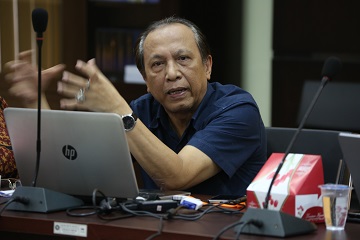
One of the Professor Chair Holders of the Faculty of Fisheries and Marine Sciences of Bogor Agricultural University (FPIK IPB), Prof. Vincentius P. Siregar, DAA, DEA, said that remote sensing technology had entered Indonesia in the 70s (aircraft mapping technology). In the early 90's, remote sensing using satellites was introduced and since then, this technology has been used as an alternative and complementary technology from conventional methods. The development of marine science and technology to understand the marine characteristics, phenomena and physical, chemical, biological and geological processes using remote sensing and marine acoustics to explore marine resources and the environment.
"This remote mapping technology is usually tandem with geographic information systems. Landsat satellite imagery is often applied to delineate coral reefs, shorelines, and other coastal features using geographic information systems (GIS) in Indonesia and in other countries. Although habitat maps have obvious uses in coastal management, the term habitat is rarely defined explicitly. Habitat mapping can be done using sonar, aerial photography or aerial hyperspectral sensors, and/or satellite imagery. Satellite imagery has the advantage of lower cost and the potential to map larger areas. It compiles all spatial information from satellite images into more informative derivative information of its nature, "he said in his scientific oration for his Professorships in the Andi Hakim Nasoetion Auditorium, IPB Campus, Dramaga, Bogor, 16 December 2017.
According to Prof. Vincent, stated that Indonesia has favourable geographic characteristics. It possesses an abundance of both renewable and unrenewable resources such as fisheries and offshore oil and gas. Yet marine resources are threatened by overfishing and coastal development, limited spatial management of coastal ecosystems, and other pressures. A large and growing array of ecosystem science confirms these facts, but this science is not yet being translated into the engineering, financial and policy language that could drive changes in the way we evaluate and manage nature for our many needs. In the right hands, ecosystem service science will help decision-makers, development organizations, industry and community members make important planning decisions about coastal areas. Thus. ocean resources must be mapped to generate information that could be used for decision making.
" Ocean life survived the long, gradual change, but the current speed of acidification is very worrisome. The term ‘remote sensing’ is broadly defined as the technique(s) for collecting images or other data about an object from measurements made at a distance from the object, and can refer, for instance, to satellite imagery, to aerial photographs or to ocean bathymetry explored from a ship using radar data. By Remote Sensing Techniques, we observe multiple time series of observations, each of which is relatively short, sparsely observed, or noisy. If we do not make a relatively short observation then we can’t obtain accurate data. Remote sensing is nothing but a means to get the reliable information about an object without being in physical contact with the object. We urgently need a map that will be needed for part of national development, "he said
In his scientific oration on "Peran Teknologi Penginderaan Jauh Satelit Penyediaan Informasi Geospasial Habibat Perairan Laut Dangkal (The Role of Satellite Remote Sensing Techniques in the Provision of Geospatial Information of Marine Shallow Waters Habibat)", Prof. Vincent explained that marine resources both biological and non-biological, are usually detected or monitored by technology. Traditional water quality monitoring typically involves costly and time consuming in-situ measurements, and boat surveys.
The remote sensing division of marine information system of IPB has been using remote sensing technology since 1995. One example of it works is the mapping of Supended Sediment Load Concentration (MPT) and chlorophyll-a in Jakarta.
" Chlorophyll-a is used as a proxy for phytoplankton biomass and can be an indicator of increased nutrients, is useful to describe the level of water fertility. This is important for the fishery because if the high fertility of the water will provide the success of aquaculture. Oceanic environment supporting the parameters would explain the oceanic environment and food resource availability in an ecosystem in exploring fishery resources. MPT or Suspended sediment is generally transported within and at the same velocity as the surrounding fluid (water or wind). Suspended Particulate Matter (SPM) carries pollutants, shades light and so inhibits primary production, and embodies particulate organic matter forming part of the marine ecosystem The stronger the flow and/or the finer the sediment, the greater the amount of sediment that can be suspended by turbulence, will pose substantial environmental and economic challenges. Remote sensing measurements of ocean colour provide time series for studying variability of suspended material, phytoplankton pigments and coloured dissolved material., "he explained.
Various research program on th utilization of remote sensing for marine fisheries he the his team have carried out, Prof. Vincent concluded that the accuracy of satellite image mapping including the classes on the map varies greatly by both local and foreign researchers. The main factor affecting accuracy is the water turbidity level.
"Sediments entering the water as a result of coastal development or pollution can cause changes in water turbidity – a measure of the amount of particles suspended in the water. Comprehensive water quality climate data records have the potential to provide rapid water quality assessments, thus providing new and enhanced decision analysis methodologies and improved temporal/spatial diagnostics. Knowing where the sediments come from is critical to managers because turbidity cuts off light to the bottom, thwarting the natural growth of plants. If we can track the source of turbidity, we can better understand why turbidity is changing, "he said.
In addition, other obstacles are high levels of vulnerability in Indonesia (researchers generally find it difficult to get cloud-free satellite imagery). The level of attenuation in the water column (in the water column there is chlorophyll and others, this is the inhibiting factor). The diversity of benthic habitat in a single pixel coverage (mixel). The ability of users to describe based on spatial, spectral and radio metric resolutions. Limited facilities and infrastructure and availability of satellite imagery still depend on external provider (such as SPOT from Airbus and WV from Digital Globe). (Wied)