Intercafe of LPPM IPB Organized the International Seminar o Cocoa
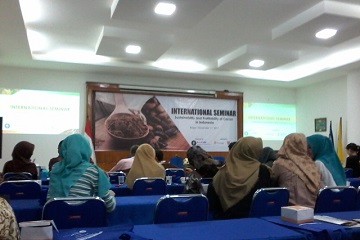
International Center for Applied Finance and Econimics (Intercafe) of the Institute of Research and Community Empowerment of Bogor Agricultural University (LPPM IPB) organized an International Seminar on "Sustainability and Profitability of Cocoa in Indonesia." The Seminar was implemented at ETDC-PKSPL, IPB Campus, Baranangsiang Bogor, on 11 December 2012..
The Director of Intercafe of LPPM IPB, Dr. Nunung Nuryartono, reported that this collaborative seminar between Intercafe with University of Sydney and University Hassanudin, under the cooperative umbrella of Australia-Indonesia Center (AIC, Cluster Food and Agriculture) has conducted a multidisciplinary research to provide input to policy makers related to complexity of problems encountered in cocoa commodity development in Indonesia. The research on "Sustainability and Profitability of Cocoa Based Farming System in Indonesia" has entered its final stages. "Various results have been obtained, so it is important to organize an international seminar related to present the result of research conducted," he said.
He added that the international seminar was organized to obtain a new perspective related to the sustainability of cocoa plantations in the future; and to provide strategic steps for policy makers in relation to the sustainability of cocoa cultivation in Indonesia.
Vice Rector for Research and Cooperation of IPB, Prof. Dr. Anas Miftah Fauzi, in his opening remarks stated that the event said was very important to establishing current best practice, implementing research into practice, to improve the productivity better seen from various disciplines. He hopes the seminar puts Indonesia in a potentially fortunate position as the country is one of the largest producers and exporters of this commodity.
Keynote Speaker for the seminar was delivered by Director General of Plantation Ministry of Agriculture, Ir. Bambang, MM. He said this seminar has awakened our consciousness, how important the Plantation Commodities. "Plantation products contribute 429 trillion rupiah to Indonesia's gross domestic product (GDP), exceeding oil and gas. If we pay attention, then productivity will be increased many times greater, "he said.
He said, our duty to protect cocoa. Farmers no longer pay attention to cocoa. As other commodity prices rise, cocoa falls. Falling income would discourage farmers from tending their crop, which may cut production in the long term. Indonesian cocoa farmers have been grappling with disappointing harvests in recent years due to crop diseases and pests as well as adverse weather. This situation could get worse, as experts predict that climate change could cause prolonged dry periods and more extreme rainfall in the wet season. Therefore, both the quantity and quality of Indonesian beans are very low. This is a threat to the world cocoa. "Do not expect Indonesia to be world largest producer of cocoa beans. We must push the price to be competitive. Therefore, this seminar is a very strategic momentum for cocoa development. On various occasions, the president and the minister called on let's continue to improve the plantation commodities, "he explained.
Indonesia the world's third largest producer of cocoa beans. Cocoa supply from Indonesia is approximately 12 percent of the world's total supply. Cocoa production provides the main source of income of millions smallholder farmers and their families in Indonesia. Smallholders contribute more than ninety percent of national production; the remainder comes from state-owned plantations and private estates. However, the country is facing difficulties in increasing cocoa's important role in the economic development of Indonesia. Around 90 percent of Indonesia's cocoa output is produced by smallholders who lack the financial support to optimize production capacity, resulting in declining productions due to aging trees, diseases, and floods. To be sustainable in order to meet cocoa demands in the world as the third largest cocoa producing country in the world, intensification system on cocoa farming practices in Indonesia should combine between modern agriculture and local wisdom into farm management with considering environmental aspects which provides ecosystem services, shaded system, implementing genetic with respond to climate change, and use resources efficiently and returns from external inputs that should taking into account biophysical and social context in the society.
One of the speakers for the seminar was David Guest from the Sydney Institute of Agriculture, the Sidney South-East Asia Center who presented his research result on "Technical Efficiency of Cocoa Farming in Polewali Mandar, West Sulawesi". (Wied)