A Group of Students of IPB Utilized wall lizard as Biopesticide
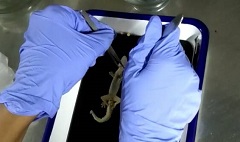
Agrochemicals play an important role on the efficient and economic production of agricultural products. Major group of agrochemicals are pesticides including herbicides, insecticides and fungicides. Of these various pesticides, insecticides have a longer and more noteworthy history, perhaps because the number of insects labeled "pests" greatly exceeds the number of all other plant and animal "pests" combined. Many types of insecticides are available in the Indonesian market. However, up to now the traditional insecticides synthesized traditionally is still rare used. Effective alternatives to traditional pesticides are desirable for both pests to reduce impacts on natural enemies and broaden control options in an effort to minimize pesticide resistance via rotation of control materials. So whether there are insecticides made from natural that have advanced technology and developed?
To answer the challenge, a group of students from the Faculty of Agriculture, Bogor Agricultural University (IPB), namely Ahmad Firdaus, Ajeng Kurnia Dewi, Amalia Styaningrum, Ariska Nugreheni and Ernita Rahmawati proposed to get funding support from 2017 Program Kreativitas Mahasiswa (PKM–P Student Creativity Program) to implement their study program to do different innovation by making natural insecticides derived from home lizard.
Historians have traced the use of pesticides to the time of Homer around 1000 B.C., but the earliest records of insecticides pertain to the burning of "brimstone" (sulfur) as a fumigant. Pliny the Elder (A.D. 23-79) recorded most of the earlier insecticide uses in his Natural History. Included among these were the use of gall from a green lizard to protect apples from worms and rot. Later, we find a variety of materials used with questionable results: extracts of pepper and tobacco, soapy water, whitewash, vinegar, turpentine, fish oil, brine, lye among many others. Geckos are lizards belonging to the infraorder Gekkota, found in warm climates throughout the world. They range from 1.6 to 60 cm (0.64 to 24 inches). Hemidactylus (the house geckos) is a genus of the family of common geckos, Gekkonidae. It has about 90 described species, newfound ones being described every few years. These geckos are found in all the tropical regions of the world, extending into the subtropical parts of Africa and Europe. In some archipelagoes, cryptic species complexes are found. Geckos like to live in and out of houses. They are typically known as house geckos, due to their readiness to adapt to and coexist with humans and In Indonesia, we called it cicak (Cosymbotus sp.). The species will cling to vertical or even inverted surfaces when at rest. In general there are some lizards that are often found in Indonesia such as wall lizard (Cosymbotus platyurus), wood lizard (Hemidaclylus frenatus), and sugar lizard (Gehyra mutilata). Lizard survives by capturing and hunting prey using his mouth and the prey is swallowed whole. Geckos are abundant in Indonesia and are believed by Chinese and Korean traditional medicine devotees to help cure cancer as well as skin and respiratory diseases. In general, lizards prey on insects such as spiders, fruits, honey, carrion, and the most dominant of mosquito insects and flies.
The study had been carried out in the Biological Control Laboratory of IPB Plant Protection Department, utilizes digestion of the wall lizard, where chitinase enzyme were isolated. Such enzyme grows in lizard digestion. The cultivated bacteria then were undergone through the will go through several tests such as chitinolytic bacteria to determine the ability of bacteria to destroy chitin which is a component of the skin insects.
The chitinase enzyme found in lizard digestion is the main target as the raw material for bioinsecticide. Knowing that the lizard consumes its prey intact then the bacteria contained in the digestion of lizards has the potential to be used as biopesticide.
Global food security is one of the most pressing issues for humanity, and agricultural production is critical for achieving this. Exotic pests include non-native microorganisms, plants, insects, and other animals that cause or transmit diseases, displace native species, or diminish the economic or aesthetic value of a product or the environment. By producing toxins or acting as a vector for plant, animal, or human diseases, these pests may affect domestic animals, cultivated crops, forests, ornamentals, pets, wildlife and their habitats, and humans. The target object of test in this study is brown planthopper. It is a species that feeds on rice plants (Oryza sativa L.). Brown planthopper are among the most important pests of rice, and rice is the major staple crop for about half the world's population, it also caused severe yield losses for farmers.
Chemical pesticides are often used to control diseases, pests or weeds. , when overused, can cause adverse effects, such as the occurrence of immunity to target pests, damage to the environment, and even disturb the balance of the ecosystem. Other effects of these. Occupational exposure to pesticides often occurs in the case of agricultural workers, excessive use this chemical insecticides can degrade their health. So the development of bioinsecticides that are safe for its users and effective against the target pest is very necessary. Firdaus said with this research is expected to reduce the level of loss of agricultural production in Indonesia. (Wied)