
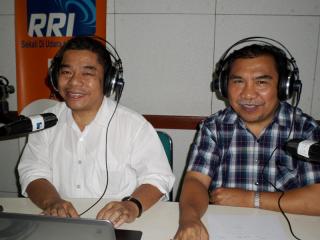
Dr. Setia Hadi Talks on Village Acts for RRI Radio Program
It has become public knowledge, that there had been an increase of overall inequality between urban and rural development prior to the reformation era. During the period of rapid globalization, the development of the urban-based manufacturing, financial and other sectors was emphasized, and there was a slowdown in agricultural growth, which caused a widening of the rural-urban gap. As a correction for the development approach to in the era of the new order, such situation were changed into the decentralized, and horizontal coordination.
It was the presentation of the Head of Planning and Regional Development Studies (Pusat Pengkajian Perencanaan dan Pengembangan Wilayah – P4W) – Institute for Research and Community Service (LPPM), Bogor Agricultural University, Dr. Setia Hadi, broadcasted by RRI Bogor, Jl. Pangrango No. 34, Bogor, in the Dialogue of Experts. During which, he was accompanied by the Secretary of P4W LPPM, Dr. Iskandar Lubis.
According to him, the centralized, sectoral, and vertical approaches have caused many problems of development, including the disparities development of classes, and actors for the regional development. With the formulation of the Act No. 6 in 2014, it is expected that they will respond to the inequality of the village authority to plan and implement rural development.
As stipulated by article 19 of Law No. 6/2014, Village chiefs are authorized to: (1). Run the village administration; (2). Appoint and dismiss the village officials; (3). Manage the financial and assets of the village; (4). Set the village regulations; (5). Plan the village income and expenditure; and (6). Fostering the welfare of the villagers.
In addition, village chiefs are also authorized: (7). In promoting peace and order among villagers; (8). Developing and improving economic conditions village; (9). Developing source of village income; (10). Proposing and receiving the state properties; (11). Developing social and cultural life; (12). Utilizing appropriate technology; (13). Coordinating the development of village participatory process; (14). Representing the village in law, and (15). Executing other authority in accordance with the provisions of legislation. (Wied).

