
Training on Occupational Health Safety and Environmental Protection (K3LL) of the Students of MSP IPB
In the framework of compulsory co-curricular activity with the theme of Application of Work Safety in the Field, and producing the graduates of Strata-1 having the competitiveness to face the working work, Department of Water Resource Management (MSP) held the training on Occupational Health Safety and Environmental Protection (K3LL) addressed to the students of Water Resource Management of 48th batch. This training was implemented during two days on the dates of 11-12 October 2014.
The first day of training activity was implemented in the Room of Fisheries Resource Management 1 (MSPi-1) 4th Floor Wing 3 Building of Faculty of Fisheries and Marine Science – IPB. The agenda was the debriefing of safety procedure of outdoor activities from Indonesia Nature Film Society. The trainers in the debriefing of this K3LL were Mr. Wahyu Mulyono, who was the alumni of MSP of 33rd batch, and his two colleagues Mr. Aming and Mr. Yopi. The material was about the Management of Travel and Expedition. The students were taught about the importance to know the obstacles or barriers from the nature when conducting the activity in the nature and how to handle it. In principle, there were four kinds of stage that should be conducted in this expedition activity, namely: planing stage, preparation stage, implementation stage and completion or post-field stage.
The class was divided into eight groups of discussion based on the theme or the research team. Then every group was assigned to structure the management consisting of head, field coordinator, medical parts, consumption parts, transportation logistics, financial administration, and other sections. The goal was that the team had a job description and a clear management in the implementation of research. Further, the team analyzed the barriers or technical constraints and any hazards that might occur during the research and how to overcome them. The team should also prepare a list of security equipment needed to ensure safety and the smooth running of research.
The next material which was also not less important was of the diseases of Hypothermia which often occured. Hypothermia was defined as the state of the body’s core temperature which was lower than 35 degrees Celcius. This could occur suddenly when someone was too long in the cold water or some times after the exposure to cold temperature.
The first day material was ended with the debriefing about the procedures for crossing the river as an obstacle that had to be known. Techniques to cross the river would be simulated on the next day.
The second day of training activity was implemented in Lake LSI, Campus of IPB Dramaga. The concept of this second day activity was the simulation technique of river crossing and the training of Basic Sea Survival (BSS). BSS Materials taught covered the procedures for forming the Heat Escape Lessening Procedure (HELP) Position aiming to reduce the loss of body heat, HUDDLE Position functioning to warm up to each other, to swim in groups, and the victim while in the water. After finishing the training in the lake, the students returned to the class to have the debriefing, evaluation and closure.
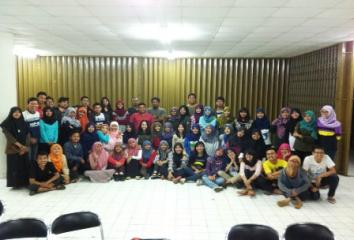
The training event was closed with the group photo among the students of MSP 48 with the trainers. (Dept. MSP)

