Spreading Gogo Rice Technology to the Far Corners of the Country
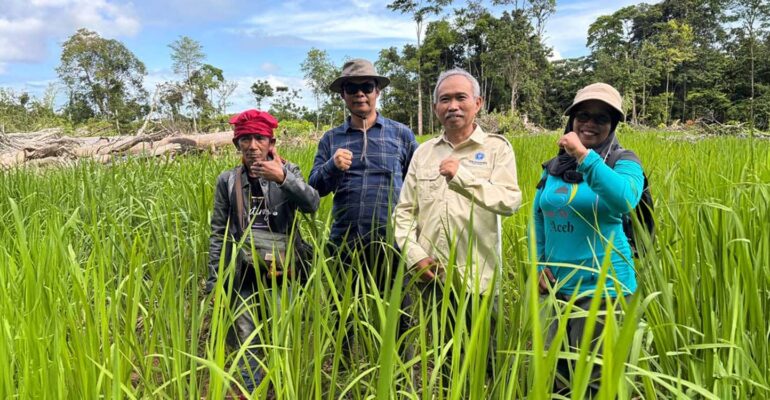
The Faculty of Agriculture (Faperta) at IPB University remains committed to supporting increased production and productivity of food crops in various regions of Indonesia.
Recently, Faperta conducted the dissemination of gogo rice cultivation technology in Berau Regency, East Kalimantan (Kaltim), which has long been one of the traditional areas for dryland rice cultivation.
“If you want to see a model of gogo rice intercropping with smallholder oil palm, you can find it in Dumaring, Berau, East Kalimantan,” said Prof Suryo Wiyono, Dean of the Faculty of Agriculture IPB University, during a discussion with farmers in Dumaring (2/16).
In this area, Prof Suryo continued, the community has a strong cultural foundation in gogo rice cultivation. “This is the main capital for the success of upland rice cultivation. IPB is here only to make improvements,” he said.
Gogo rice cultivation has become a tradition for the people of Berau. However, farmers still face various obstacles, including relatively low productivity, a long harvest period of up to six months, and the need to move to new land due to the rapid decline in soil fertility.
Through collaboration with PT Aksenta and the Patikraja community, Faperta IPB University presented innovations in improving gogo rice cultivation technology. These improvements include the use of the superior IPB 9G variety, seed immunization, and more precise and balanced fertilizer management.
This activity was carried out on 4 hectares of land in the Dumaring area, which is administratively part of Patikraja Village, Talisayan District, Berau Regency.
“The IPB 9G variety that was introduced has a shorter harvest period compared to the local varieties commonly used by farmers. In addition, this variety is relatively more resistant to disease and has good growth performance,” said Prof Suryo.
Abdul Muin, a community leader in Patikraja, admitted that he was very interested in IPB University’s rice because of its good growth, strength, and other technologies offered, such as pest and disease control technology.
“The results of technology from the campus should indeed be applied to farmers like this, so that agriculture in the community can be more advanced,” he emphasized.
Through this initiative, the Faculty of Agriculture at IPB University reaffirms its role in transforming research outcomes into tangible solutions for the community, particularly in supporting food security and strengthening sustainable agricultural systems in East Kalimantan. (*/Rz) (IAAS/DON)