SV IPB University Lecturers Train Garuda Fish Farming Group Members in Maggot Cultivation Techniques
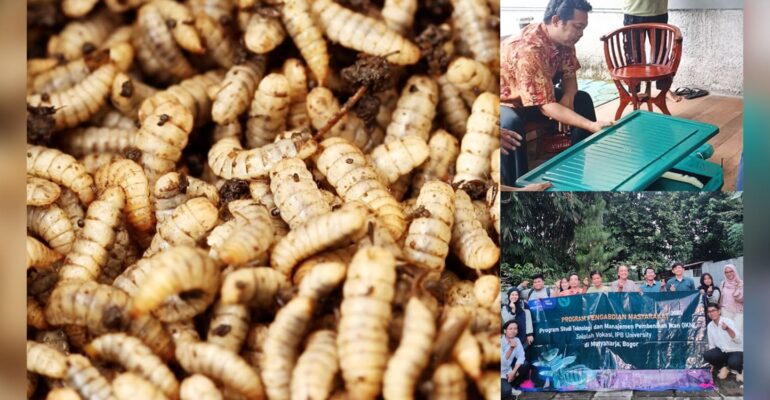
The Fish Hatchery Technology and Management Study Program (IKN), IPB University Vocational School, conducted an activity entitled “Socialization of Maggot Cultivation as Additional Fish Feed” for fish farmers in Mulyaharja Village, Bogor City.
The socialization was conducted for the Garuda Fish Farmers Group (Pokdakan) with the aim of introducing an innovative alternative feed based on maggots (black soldier fly/BSF) that is economical, environmentally friendly, and easy to implement by fish farmers.
This activity was coordinated by Dr Imam Tri Wahyudi, a lecturer at the IKN Study Program who is also active in research on functional feed development and aquaculture production efficiency.
“This activity is a form of IPB University’s tangible contribution in encouraging the application of appropriate technology in the community, especially in efforts to reduce feed production costs, which are the largest component in fish farming,” said Dr Imam.
The main speakers, Dr Andri Hendriana and Dr Mohamad Iqbal Kurniawinata, gave presentations on fish nutrition, efficient feed formulation, and maggot farming techniques as an additional source of protein for catfish, tilapia, and ornamental fish.
Dr Andri explained that maggots contain protein (35–55%) and fat (25–30%), which are important for fish growth. “With their high nutritional content, maggots can reduce the use of commercial feed, whose prices continue to rise. However, the maggot medium also needs to be prepared properly so that the nutritional quality of the maggots is optimal,” he said.
Meanwhile, Dr Mohamad Iqbal Kurniawinata emphasized the environmental and sustainability aspects of maggot cultivation. BSF larvae are capable of decomposing organic waste such as food scraps, tofu pulp, and rotten vegetables into high-protein biomass. “Maggot cultivation is not only economically beneficial, but also supports organic waste management in the community,” he explained.
In addition to theoretical explanations, participants who are members of Pokdakan Garuda were also introduced to maggot cultivation techniques, from media preparation and larva maintenance to the harvesting and processing of maggots as fish feed. Participants showed great enthusiasm because this cultivation method can be implemented with simple equipment and low costs.
The event was interactive and ended with a discussion session between the team of lecturers, students, and members of Pokdakan Garuda. Through this activity, the IKN Vocational School Program at IPB University continues to be committed to implementing research results and innovations in the community to support feed independence, cultivation efficiency, and local economic sustainability in the fisheries sector. (*/Rz) (IAAS/LAN)