Himasper IPB University Holds Talkshow Themed Managing Aquatic Resources as a Blue Carbon Asset
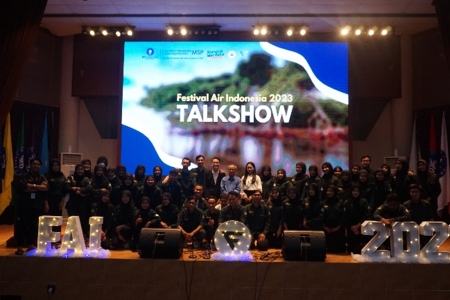
The Student Association of Aquatic Resource Management (Himasper), Faculty of Fisheries and Marine Science (FPIK) IPB University held a Talkshow on Indonesian Water Festival 2023. With the theme 'Managing Aquatic Resources as Blue Carbon Asset', this Himasper megaproject was held at Andi Hakim Nasution Auditorium, IPB Dramaga Campus, Bogor.
Dean of FPIK IPB University, Prof Fredinan Yulianda on the occasion said that blue carbon is a topic that is often discussed. Blue carbon is closely related to human activities, including industrial activities. Industrial activities can cause an increase in the level of carbon concentration, both in the air and in the water.
"Carbon has both positive and negative sides. Carbon can be utilized and can also cause imbalances in nature. Therefore, it requires a variety of appropriate roles from all parties, including the government, academics, practitioners and the community so that an integrated management system can be optimally achieved," he said.
Blue carbon is a term known for carbon emission reserves that are absorbed, stored and released by coastal and marine ecosystems. Until now, ecosystems considered as blue carbon ecosystems include mangrove, seagrass and tidal marsh ecosystems. Coral reef ecosystems are still not included in the blue carbon category because the absorption and release of carbon in coral reefs are still considered the same, so nothing is stored in their bodies so further research still needs to be done.
Mangrove and seagrass ecosystems have the most ability to absorb carbon. Seagrasses absorb 35 times the rate of terrestrial carbon. However, both of these ecosystems are under high threat of destruction. About 60 percent of existing mangroves have been degraded. Likewise, seagrasses continue to decline.
This is a challenge in managing blue carbon ecosystems. Existing governance is considered insufficient, especially related to mangrove ecosystems. However, the Indonesian Ministry of Environment and Forestry (KLHK) is currently working on the protection and management of mangrove ecosystems.
In addition, another regulation in the Coastal Zone and Small Islands Zoning Plan (RZWP3K) has introduced coastal ecosystem zones or also known as blue carbon zones. Mangrove areas not included in the forest area will be protected in regional regulations so that mangrove utilization is limited. On the other hand, in mangrove management not only are the species protected but also the habitat as a living space so that it should not be disturbed.
The current challenge is that there is still a debate between economic and ecological aspects. If people protect mangroves, what will they get? This is also related to carbon trading.
Carbon trading is classified into two categories: carbon crediting and cap and trade (emission trading). The World Bank has allocated 320 billion to East Kalimantan as an effort to reduce emissions.
Present as speakers were M Yusuf, SHut, MSi (Director of Management and Utilization of Coastal and Small Islands, Ministry of Maritime Affairs and Fisheries/KKP), Ir Inge Retnowati, ME (Director of Inland Waters and Mangrove Rehabilitation, KLHK) and Muhammad Imran Amin (MER Program Director, Yayasan Konservasi Alam Nusantara). The talk show moderated by Dr Fery Kurniawan, (MSP Lecturer) was also attended by Prof Hefni Effendi (Head of MSP Department, IPB University). (*/Rz) (IAAS/ANF)