Himasiter IPB University Conducts Silage Feed Making Training in Cihideung Ilir Village
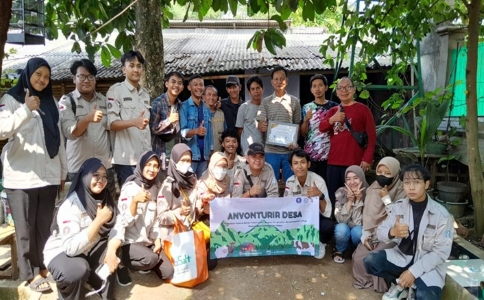
The Animal Nutrition and Food Student Association (Himasiter) of the Faculty of Animal Science (Fapet) of IPB University conducted training activities on making silage feed for sheep and goats in Cihideung Ilir Village, Bogor, West Java.
Dodi Wahyudi, Head of Himasiter IPB University said, the training on silage feed making aims to provide new knowledge to farmers so that they can increase feed efficiency and livestock productivity which in turn can increase their income.
The training was delivered by Hajrian and Hadi who are alumni of the Department of Nutrition and Feed Technology (INTP) Fapet IPB University. It was held at Supriadi’s sheep farm, one of the farmers in Cihideung Ilir village.
“Silage feed is a feed made from fresh grass that is fermented using EM4 and molasses. The fresh grass can be elephant grass, king grass, dwarf elephant grass and many more,” Hajrian explained to the farmers.
According to him, the process of making silage feed is very easy. First, the elephant grass is chopped to a size of 5 cm. Next, the chopped grass is mixed with EM4 and molasses until evenly distributed. Finally, the grass is stored in a plastic trash bag and then vacuumed to ensure the grass is anaerobic.
“The fermentation time for silage feed is only one week and can be given directly to livestock. The quality of silage feed can be seen from the color and smell. If the color of the fermented grass is still greenish and there is no fungus and the smell is fragrant, then the quality is good,” he explained.
Hadi adds that silage feed has many advantages over other feeds such as concentrate. “Silage feed is more durable, can improve palatability, is more efficient and easy to make and can reduce operational costs,” he said.
In addition, he continued, making silage feed aims to maintain the availability of feed, especially forage all the time. This is because weather factors are often a common problem in the provision of forage.
“During the rainy season, forage is available in abundance, even exceeding the needs. However, during the dry season forage is lacking due to dry land conditions. Hence the making of silage feed to provide forage feed all the time. The feed is processed through fermentation to make it more durable,” said Hadi.
Supriadi as a farmer thanked Himasiter IPB University for organizing this training. He admitted that so far the farmers in his village had never received similar training, so their livestock were only given fresh grass and during the dry season they had difficulty finding grass.
“After this training, I and the farmers in Cihideung Ilir will try to make our own silage using the abundant grass during the rainy season so that the availability of feed can be maintained all the time,” he said enthusiastically. (*/Rz) (IAAS/ARD)