Two IPB University Academics Describe the Importance of CSR Insertion in Empowering Young Farmers and Opening Market Access
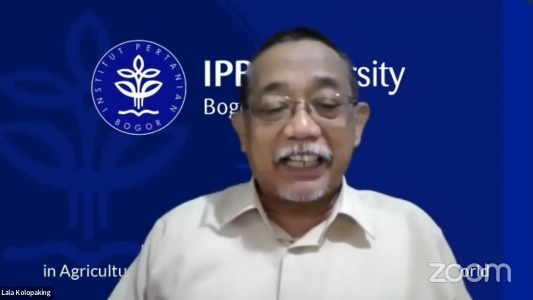
Dr Lala Kolopaking, Head of the Rural Sociology Study Program of the Graduate School of IPB University explained that corporate social responsibility (CSR) assistance should be able to empower farmers to deal with two issues, namely handling the farmer crisis and the issue of food crisis. CSR protocols can be utilized for the protection and empowerment of young food crop farmers in the digital era.
"CSR needs to encourage precision agriculture as an effort to increase the participation of the younger generation in the agricultural sector," she said in the National Seminar on 'The Role of CSR in Helping Empower Food Crop Farmers', a collaboration between the Indonesian Ministry of Agriculture and the Indonesian Women's Bachelor Association (27/03).
According to her, agriculture in the future is based on the use of precision technology to support sustainable food agriculture ecosystems. The goal is to increase efficiency and productivity, create innovation and encourage inclusiveness. Departing from digital transformation, the younger generation can be empowered to increase the added value of digital-based agricultural products and data integration.
"If we want to attract CSR then we must have a precision agriculture policy at the national level. Obviously, this will attract the involvement of farmers whose base has been involved in digitalization since young or digital citizens," he continued.
He added that the implementation of CSR in relation to the empowerment of food farmers needs to be a relationship of mutual protection and empowerment between farmers from the younger generation in the ecosystem of precision food agriculture in a fair manner.
"The real action of CSR implementation in the future also needs to strengthen the social position of young food farmers in accordance with the principle of Youth Engaged Development to Community Emergence. In synergizing the role of farmers, it also needs to be initiated at the local government level," concluded Dr Lala Kolopaking.
Prof Tajuddin Bantacut, Professor of the Faculty of Agricultural Technology (Fateta) IPB University added that CSR needs to generate long-term cooperation between producers, processors and consumers. Currently, agricultural technology and logistics are still limited.
"CSR can be inserted into the value chain in food distribution. This effort is integrated and programmed in order to solve agricultural problems upstream and downstream. This step should be done like an annual development plan with the help of CSR financially and other support," added Prof Tajuddin. (MW) (IAAS/ARD)