IPB’s Students Formulate an Economical Biogas from Rumen’s Waste and Blood of Cows
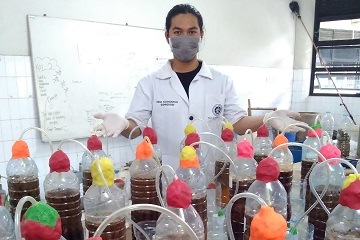
The usage of renewable energy is an important and urgent issue especially regarding the scarcity of fossil fuel in the future. IPB’s students provide a solution in the form of renewable energy that is economical, environmentally friendly and has great potential. The solution is producing biogas from rumen’s waste and additional blood of cows that are the main substrate.
Students that are involved are Erik Kurniawan and Annisa Rosmalina from Faculty of Animal Science, and Vegoma Fazatha from Faculty of Forestry. They are supervised by Iyep Komala, S.Pt, M.Si, as one of Faculty of Animal Science lecturers. This research became one of PKM 2018’s finalists in the research field.
“This idea came from our concern towards the rumen’s waste and blood of cows produced by the Slaughter house (RPH) that could contaminate soil also water and have not been used properly. However, the rumen’s waste can actually be used as substrate innovation in producing biogas. Usually in the making of biogas, people tend to only use animal waste and dried leaves as the main substrate.” explained Annisa.
Fazatha said that the components of rumen’s waste have special advantages rather than other substrate that commonly used in producing biogas.
“Rumen’s waste is a product of a half-digestion system from the whole process of feed digestion in cow’s stomach, so this waste shaped like straws that haven’t been digested completely into animal waste. Rumen’s waste contained of cellulose and hemi-cellulose component that is good for producing biogas. However the high level of lignin component might slow down the fermentation process in the making of biogas. Therefore, we did the alkali pre-treatment , an action of giving base, 2% NaOH concentration to reduce the lignin. How about the addition of the cow’s blood, why it is added? It is because if 5% concentration of cow’s blood added it could increase the biogas volume and its methane content by 52%. The number is higher than the conventional one.
Erik and his team hope that this biogas formulation could be applied in every RPH in Indonesia as a solution to reuse the rumen’s waste and blood of cows.
“The aim of the formulation is biogas could be made from rumen’s waste and cow’s blood as its substrate and could be applied in RPH to reduce the waste and decrease the contamination on the environment. We hope that this biogas could be an economical renewable energy because we applied the zero waste concept and this biogas also environmentally friendly.” Stated Erik. (AVR)