
Researchers of IPB Explained the Role of Fern Weeds as the Land Cover Plants in Plantation
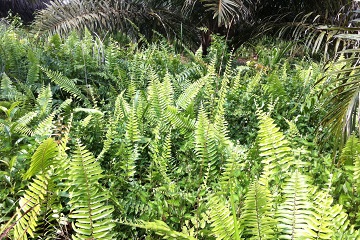
Fern weeds with the scientific name of Nephrolepis biserrata had the benefits as the land cover plants. It had a growth that was not too fast, growing in the form of shrubs, and its existence did not cause much harm or disturbance, so that this plant tended to maintain its presence in the palm oil plantation.
Team of the researchers consisting of Sudirman Yahya, Suwarto from the Department of Agronomy and Horticulture, Faculty of Agriculture (Faperta), Bogor Agricultural University (IPB); Kukuh Murtilaksono from the Department of Soil Science and Land Resources, Faperta of IPB; Mira Ariyanti from the Department of Agricultural Cultivation, Faperta of Padjadjaran University; and Hasril H. Siregar from the Research Center for Oil Palm, Medan, examined the role of the fern weeds as the cover plants on the palm oil plantation.
“The weeds as the undesirable plants grown in the palm oil plantation area can actually be exploited, so that their presence is not entirely harmful. One that having benefits is N.biserrata. Initially, it is maintained and propagated to keep moisture around the the principal of the palm oil. Furthermore, the plant is used as a vegetation that plays a role in the soil and water conservation activities around the area of the palm oil cultivation as the land cover plants,” said Sudirman.
Based on these factors, some private plantations had used N.biserrata as the land cover plants. Other than that, N.biserrata was the happy shade plants, so it was possible to be planted in the area of the producing palm oil plantation (TM). Planting the land cover plants could be categorized as the activities to support ISPO (Indonesian Sustainable Palm Oil System), namely the plant maintenance in support of the plant productivity.
This researcher explained that the optimal plant spacing for its cultivation in the field as the land cover plants was 10 cm x 10 cm of this plant acting as the land cover plants in the area of the palm oil plantation yielded due to contribute the nutrients of 15.7 tons of dry weight per hectare per year with the carbon stock of 7.7 tons C per hectare per year.
“The plant spacing of 10 cm x 10 cm is the recommended plant spacing. Other than that, the highest numbers of leaves are also obtained by planting N.biserrata at the plant spacing of 10 cm x 10 cm,” he said.
At 20 MST (plant age) of this plant yielded the percentage of the land cover of 94.16 percent (%), 82.16 %, 72.83 % respectively for the plant spacing of 10 cm x 10 cm, 20 cm x 20 cm, and 40 cm x 40 cm. This weed also affected the water balance that occurred in the producing palm oil plantation, namely by reducing the occurrence of groundwater deficit in the dry season or the month with low rainfall. The planting of N.biserrata as the land cover plants in the palm oil plantation resulted in a role in reducing the water deficit by 36.71 percent.
“During the decomposition process, N. biserrata increases the soil nutrient content, i.e. N, P, K and C-organic respectively of 41 %, 11 %, 93 %, 11.3 %,” he said.(IR/nm)

