IPB’s Professor: Degradation is Inevitable Consequence of Development
The increase of agricultural production can no longer be carried out by intensification strategy, especially with the demands of self-sufficiency. There should be an expansion of agricultural land. The possible alternative way is by carrying extensification strategy i.e. opening forest area. However, there must be some pressures on environmental issues.
“Most farmers only have as much as ??0.2-0.49 hectares of land area which is almost impossible to fulfil their basic family needs, even less to meet the food needs of 261 million people of Indonesia. This can be compared to the developed countries such as America and Australia who provide, respectively, 71 and 50 per cent of their land for agriculture.
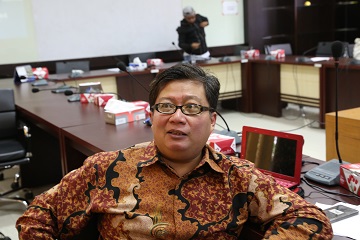
Their advanced in agriculture is because they pay more attention to the agricultural land, "said Professor of Faculty of Forestry (Fahutan) of Bogor Agricultural University (IPB), Prof. Dr. Dodik Ridho Nurrochmat, in the scientific oration of his professorship inauguration at Andi Hakim Nasoetion Auditorium, IPB Campus, Dramaga, Bogor (16/12).
He added that in the early stages of development, the increase of per capita income was almost certainly followed by environmental degradation. However, there will be recovered at a certain turning point. That's what happened to developed countries.
After reaching a certain level of welfare, generally there will be a turning point where the higher the level of welfare, then the public becoming increasingly concerned about environmental sustainability. In this situation the rate of environmental degradation will decrease. However, environmental degradation can be seen as part of the development process "if and only if" the degradation happens not beyond the environmental capacity to recover.
"Therefore, as long as development is an option, we can build fast with some degradation, in the allowed limit," he said.
According to him, every living creature has the ability to adapt to environmental changes. Therefore, the concept of sustainability should be understood in the context of the human ability to create and adapt to environmental changes. Environmental restoration efforts should not be defined as zero environmental degradation. Environmental restoration needs to be carried out to the extent of reasonable human adaptability.
There is no institutional model of forest management that is appropriate for all conditions. The institutional choice strategy for forest resources management should be based on social capital conditions and country capacity.
"If the country capacity is strong with weak social capital, then state management will be appropriate. If the country capacity is weak with strong social capital, then better to choose community based management. If both are strong, then the best strategy is collaborative management. But if both are weak, then the choice falls on forest concession. Forest concession is the best option, because forest as common goods needs managers in the field. If there is no manager, then it will become open access forest. The policy somehow may not be implemented due to several reasons, namely bad policy, bad execution, and bad luck, "he explained.
The key strategy is not to uniform the interests of the stakeholders. The only way is to find similar intangible interests. For example, illegal logging is much related to money. If the stakeholders can generate the same amount of money from other forest activities, e.g. from a medicinal forest plant, they will prefer not to cut down the trees.
For the problem of resource allocation, Prof. Dodik said the first solution is how to use land wisely. We must share the land. We should not be too stiff because we are facing a real problem where we cannot possibly meet the need of 260 million people. Second, there is also a problem in the policy making of land conversion. Many local governments (Pemda) in Java are competing to revise the municipal governance of the region. If not revised, consequently, we could lose millions of hectares of paddy fields. Woe to us because it is not easy to replace rice fields in Java. One hectare of paddy fields in Java equals to 3-5 hectares of paddy fields in other places to produce the same rice production. This is due to different geophysical and cultural factors. "So if we lost one million hectares of rice fields in Java, we need 3-5 times land of other places, the easiest way to solve this problem is by converting forest to agricultural land," he explained. (TK)